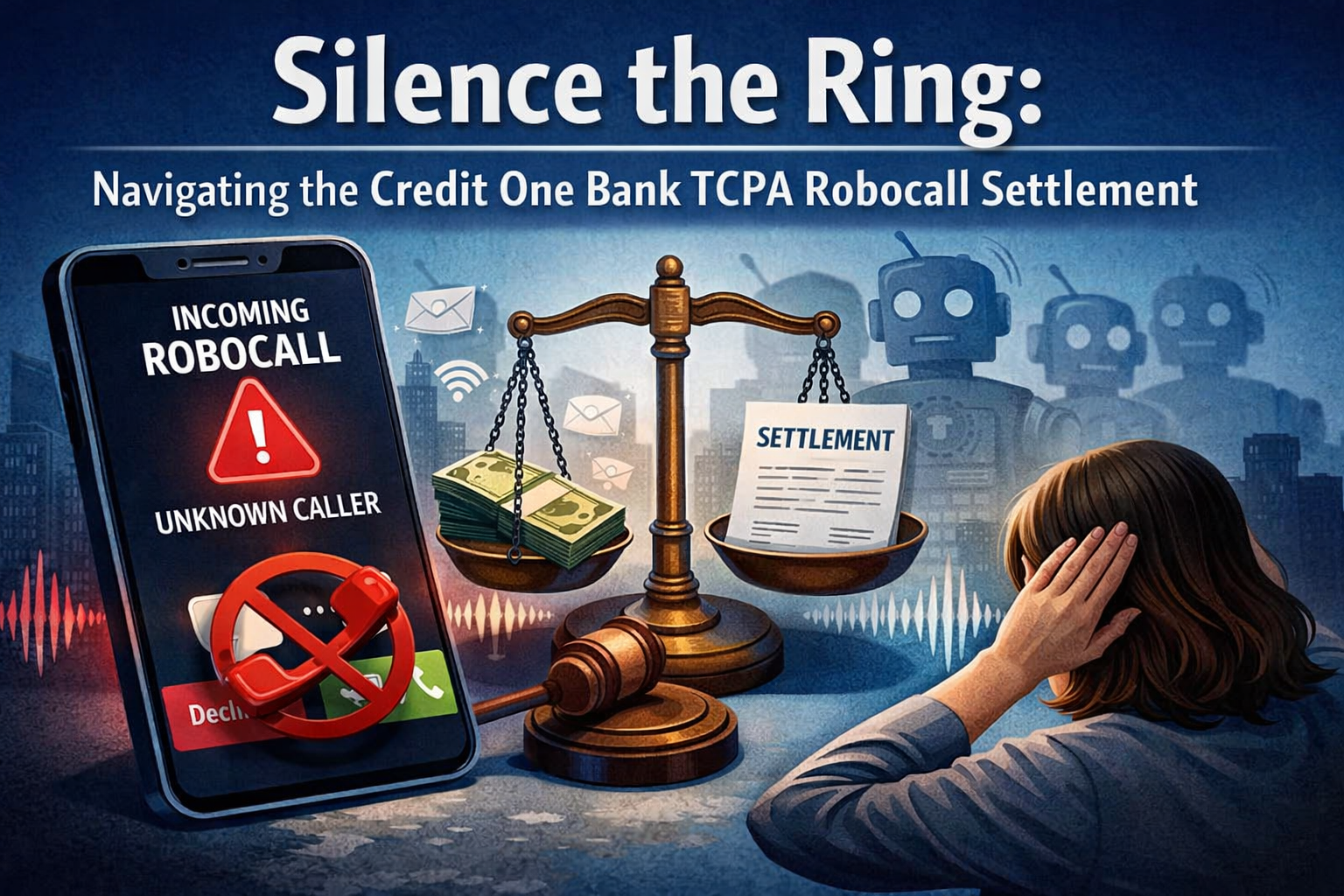
For millions of Americans, the sound of a ringing phone has transformed from a welcome connection into a source of dread. In the high-stakes world of subprime credit and debt recovery, few names appear on caller ID screens with as much persistence as Credit One Bank. While the bank provides essential credit lines to many, its aggressive communication tactics have landed it in hot water across the United States.
As of February 26, 2026, the legal pressure on the bank has reached a historic peak. From a massive $10.2 million civil penalty in California to ongoing class-action investigations, the Credit One Bank TCPA robocall settlement landscape is shifting rapidly. This article provides a comprehensive 1,200-word analysis of your rights, the recent judgments, and how you can stop the harassment.
The Federal Shield: What is the TCPA?
To understand why Credit One Bank is paying millions in settlements, you must first understand the Telephone Consumer Protection Act (TCPA). Enacted by Congress in 1991, the TCPA is your primary defense against the “robocall” epidemic.
The law is clear: companies cannot use an Automatic Telephone Dialing System (ATDS) or an artificial/prerecorded voice to contact your cell phone unless you have given “prior express consent.” Furthermore, even if you gave them your number when you signed up for a card, you have the right to revoke that consent at any time. Once you tell a caller to stop, every subsequent automated call is a violation that can cost the company between $500 and $1,500 per call.
The Landmark $10.2 Million California Settlement (February 2026)
The most significant recent blow to the bank occurred just last week. On February 19, 2026, a California statewide task force of District Attorneys—representing Los Angeles, Riverside, San Diego, and Santa Clara counties—secured a $10.2 million judgment against Credit One Bank. This enforcement action is often cited alongside private litigation as part of the broader Credit One Bank TCPA robocall settlement news cycle.
The Allegations: 8 to 10 Calls a Day
The complaint filed in Riverside County Superior Court painted a picture of “repeated, intrusive, and harassing” behavior. Prosecutors alleged that Credit One and its third-party vendors engaged in tactics that would be “highly offensive to a reasonable person.”
-
The Frequency Policy: The lawsuit alleged that Credit One actually had a policy allowing vendors to place up to eight calls per day, with two additional calls permitted under specific circumstances.
-
Consecutive Day Harassment: These calls didn’t just happen once; they occurred on consecutive days, even after consumers begged the bank to stop.
-
Wrong Numbers: Perhaps most frustratingly, the bank allegedly continued to badger individuals who had no account with Credit One but had inherited a recycled phone number.
The $1,000 Consumer Payout: Class Action Updates
While the $10.2 million California case focuses on state penalties, private class-action cases focus on direct compensation for you. Throughout 2025 and into early 2026, several consolidated cases have moved toward resolution, often culminating in a Credit One Bank TCPA robocall settlement that benefits thousands of impacted users.
Who is Eligible?
In many of these settlements, consumers who received automated calls after revoking consent are eligible for significant payouts.
-
The $1,000 Threshold: In certain “financial harm” categories, class members have been eligible for up to $1,000 in compensation. This applies to those who can prove they were charged “Express Payment” fees ($9.95) that were processed automatically without a live agent, or those whose credit scores were damaged by inaccurate reporting during the calling period.
-
Non-Customer Payouts: If you are a “wrong number” victim—someone who never had a Credit One account but was called anyway—your claim is often even stronger. Because you never had a contract with the bank, you never gave consent in the first place.
Technical Malfunctions: The “Chatbot” and “Ghost Payment” Issues
A unique aspect of the Credit One Bank lawsuit in 2026 involves the use of AI and automated payment systems.
The “Express Payment” Trap
A class action filed in New York (Waldon v. Credit One Bank) alleges that the bank takes “unreasonable advantage” of consumers by pushing them toward a $9.95 “Express Payment” fee. The bank claims these payments are handled by a live representative, but plaintiffs argue the “live” interaction is actually just a chatbot. Under the Truth in Lending Act (TILA), creditors generally cannot charge a separate fee for payments unless they involve a live customer service representative.
How to Stop the Calls and Build Your Case
If Credit One Bank is calling you today, you shouldn’t just hang up. You should take active steps to build your evidence for a potential Credit One Bank TCPA robocall settlement claim.
-
Revoke Consent Verbally: The next time they call, say clearly: “I am revoking my consent to be called at this number. Do not call me again using an automated system or a prerecorded voice.”
-
Send a Cease and Desist: Follow up your call with a certified letter. This creates a “paper trail” that is hard for the bank to ignore in court.
-
Keep a Detailed Call Log: Record the date, time, and the specific phone number used. Note if there was a “dead air” pause of 2–3 seconds before a person spoke—this is a hallmark sign of an autodialer.
Why the “Wrong Number” Victims are Vital
The legal history of these cases is full of stories about people like “A.D.,” a minor whose phone was called repeatedly for her mother’s debt. In that case (A.D. v. Credit One Bank), the Seventh Circuit Court of Appeals ruled that the child was not bound by her mother’s arbitration agreement.
This is a critical lesson for 2026: The bank cannot force you into private arbitration if you never signed their contract. If you are receiving calls for a stranger or a family member, you have a powerful “private right of action” that could lead to a settlement much larger than the standard class-action payout.
Conclusion: The Verdict on Your Privacy
The Credit One Bank TCPA robocall settlement saga of 2026 represents a turning point in consumer protection. The $10.2 million California judgment proves that state regulators will no longer tolerate “harassment as a business model.” For the individual consumer, these settlements provide a rare opportunity to hold a multi-billion dollar financial institution accountable for invading the sanctity of your home and your cell phone.
As the California Debt Collection Task Force continues its oversight and private attorneys push for final approval on various class actions, the message to Credit One is clear: your right to collect a debt does not override a consumer’s right to peace and quiet. If they keep ringing your phone, don’t get frustrated—get documented. Your call log is more than just a list of annoyances; it is the evidence needed to secure your piece of the settlement.