For the average citizen, the civil justice system can often feel impenetrable, particularly when standing against a massive, well-resourced corporation. When a single individual is harmed by a systemic corporate policy, a defective product, or a hidden financial fee, the sheer cost of hiring legal representation usually vastly outweighs the money they lost. In a traditional legal framework, this creates a dangerous power vacuum: massive entities can commit widespread, low-level harm with absolute impunity simply because no single person can afford to hold them accountable.
The class action lawsuit is one of the most powerful, complex, and controversial mechanisms in modern jurisprudence. It is a procedural tool designed to solve the problem of asymmetrical power by allowing one or more individuals to step forward and represent an entire groupoften millions of people—who have suffered the exact same harm. By aggregating thousands of minor grievances into a single, massive legal threat, the legal system levels the playing field.
This guide strips away the sensational news headlines to explore the pure legal engineering behind every class action lawsuit. We will examine why they exist, the strict procedural rules that govern their creation, the economic engines that fund them, and the systemic debates surrounding their effectiveness.
The Philosophy of Collective Redress: Why Does a Class Action Lawsuit Exist?
To fundamentally understand this type of litigation, you must first understand the economic concept of the “negative-value suit.” In standard litigation, a plaintiff sues a defendant because the financial recovery will be greater than the cost of litigating. But consider a scenario where a multinational bank illegally deducts a hidden $3.00 fee from ten million checking accounts. The bank has unjustly enriched itself by $30 million. However, it would cost an individual consumer thousands of dollars in legal fees, court costs, and expert witness fees to sue the bank just to recover their stolen $3.00.
Because the cost of litigating exceeds the value of the claim, no rational person will file a lawsuit. Without a collective mechanism, the legal system functionally permits the theft. A class action lawsuit solves this exact systemic failure by serving three primary objectives:
-
Aggregation of Power: By bundling ten million $3.00 claims into a single $30 million lawsuit, the case suddenly becomes economically viable for top-tier legal teams to pursue.
-
Judicial Economy: It prevents the court system from completely collapsing. If even a fraction of those ten million people filed individual lawsuits, the courts would be paralyzed for decades. One judge hears the evidence once, and one ruling applies to everyone.
-
Behavioral Deterrence: It forces large entities to internalize the true costs of their misconduct. The threat of a massive, aggregated financial penalty is often the only effective deterrent against systemic fraud or negligence.
The Legal Architecture: Building and Certifying the Class
A group of aggrieved individuals cannot simply declare themselves a class. The legal system utilizes strict procedural gatekeeping to ensure that collective litigation is fair, not just to the plaintiffs, but to the defending corporation as well.
A judge must officially “certify” the class before it can proceed. To achieve this certification, the legal team must definitively prove four foundational procedural pillars:
Pillar 1: Numerosity
The group of affected people must be so large that it is logistically impossible to have everyone file their own separate lawsuit or join a single case individually. While the law rarely dictates a strict minimum number, courts generally accept that any group over 40 members meets the standard of numerosity, though classes frequently reach into the millions.
Pillar 2: Commonality
This is the beating heart of the litigation. There must be a shared legal or factual question that unites the entire group. The injury must stem from the exact same corporate policy, identical contract language, or the same standardized product design. If a judge has to investigate the unique, individual circumstances of every single person to determine if the corporation is liable, commonality is destroyed, and the class cannot be formed.
Pillar 3: Typicality
The individual named at the top of the lawsuit the “Lead Plaintiff” or “Class Representative” must possess claims that are entirely typical of the rest of the invisible class members. The lead plaintiff cannot have suffered a bizarre, unique side-effect or signed a fundamentally different contract than the people they are trying to represent. Their specific grievance must serve as the standard template for the whole group.
Pillar 4: Adequacy of Representation
Because the vast majority of class members will never step foot in a courtroom or speak to the judge, the court must fiercely protect their absent interests. The judge must determine that the lead plaintiff has no conflicts of interest with the rest of the group. Furthermore, the judge heavily scrutinizes the plaintiffs’ attorneys to ensure they have the financial resources, legal expertise, and ethical standing to take on a massive corporate defense team.
The Lifecycle of a Class Action Lawsuit
These cases are legal marathons, not sprints. They follow a highly structured, multi-year timeline designed to exhaust every legal argument before a final resolution is reached.
-
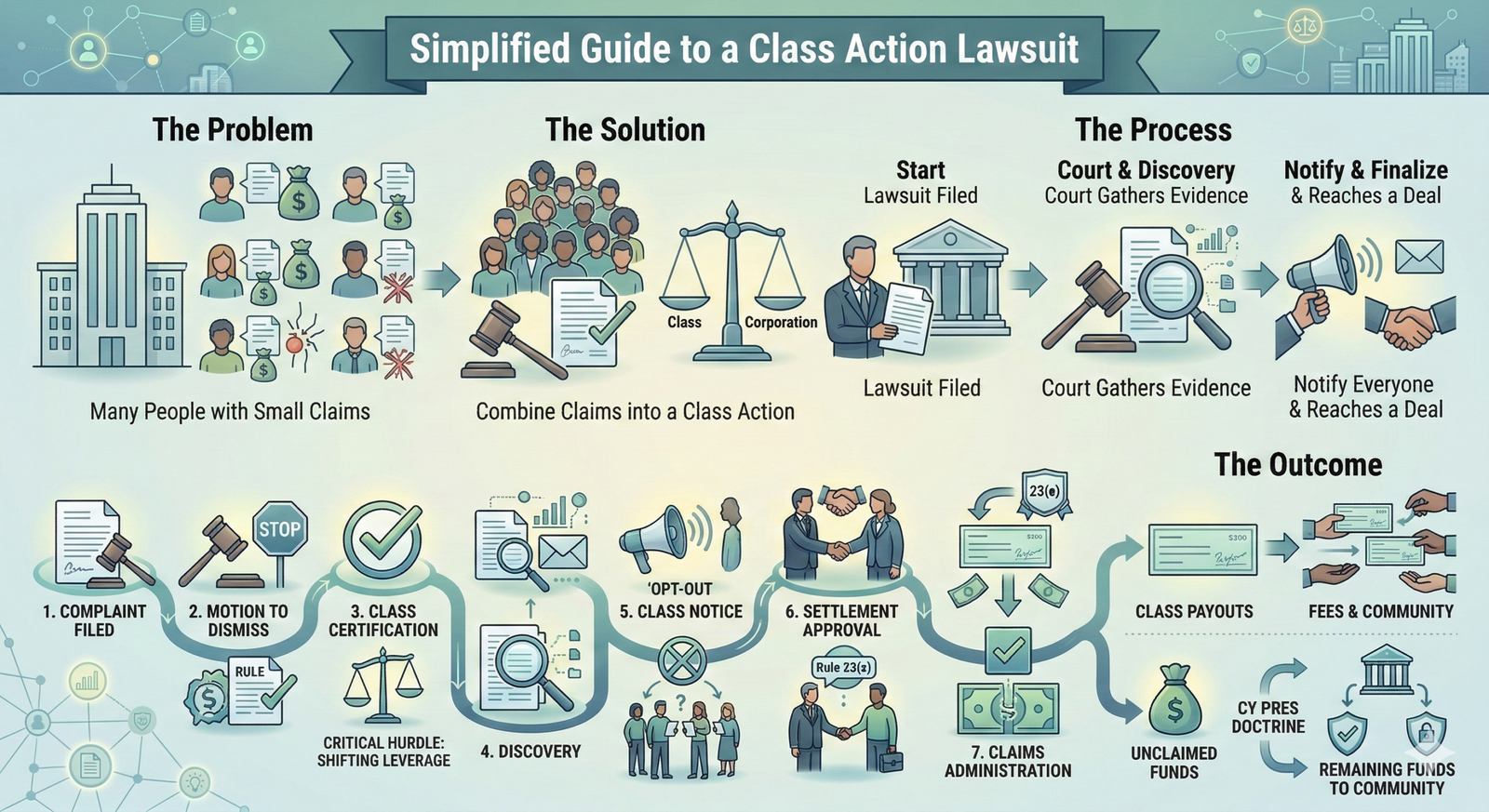
Filing the Complaint: The attorneys file the initial lawsuit outlining the alleged widespread harm and defining the proposed boundaries of the class (e.g., “All individuals who purchased Product X between 2020 and 2024”).
-
The Motion to Dismiss: The defense will almost immediately attempt to kill the lawsuit by arguing that, even if everything the plaintiff says is true, there is no valid legal claim under the law.
-
The Battle for Class Certification: If the case survives dismissal, the plaintiffs formally ask the judge to certify the class. This is the most fiercely contested phase of the litigation. If certification is granted, the leverage entirely shifts to the plaintiffs. The financial risk to the corporation becomes exponential, often forcing settlement discussions.
-
Discovery: A massive exchange of evidence occurs. The plaintiffs’ attorneys gain the legal right to demand internal corporate emails, memos, financial ledgers, and to question executives under oath.
-
Notice and the “Opt-Out” Period: Once a class is certified, the court mandates that potential class members be notified via mail, email, or widespread advertising. In most consumer cases, members are given a specific window of time to “opt out” if they wish to reject the class and retain their right to sue the company individually.
-
Settlement and Court Approval: The overwhelming majority of certified cases never go to trial; the risk of a catastrophic jury verdict forces corporations to settle. However, a private settlement is not enough. The judge must hold a rigorous “Fairness Hearing” to ensure the settlement is actually adequate for the absent class members and that the attorneys aren’t simply enriching themselves at the class’s expense.
-
Claims Administration: A neutral, third-party company is hired to build a website, review the claim forms submitted by the public, verify eligibility, and distribute the final checks or electronic payments.
The Economics: How a Class Action Lawsuit is Funded
A class action lawsuit is incredibly expensive to litigate. The legal teams must pay for expert witnesses, vast document review software, and years of attorney labor before they ever see a return on their investment.
The Contingency Fee Model
These cases operate almost entirely on a contingency fee basis. The class members pay absolutely nothing out of pocket. Instead, the law firm assumes 100% of the financial risk. If the firm loses the case, they lose millions of dollars of their own invested time and capital. If they win or settle, they are awarded a percentage of the total recovery by the judge typically ranging from 20% to 33%.
The Cy Pres Doctrine
What happens when a company agrees to pay a massive settlement fund, but only a fraction of the money is actually claimed by eligible consumers? The leftover money usually does not go back to the corporation, as that would defeat the purpose of financial deterrence. Instead, courts frequently utilize the cy pres doctrine. This legal concept directs the remaining funds to neutral, non-profit charities or research institutions whose core mission aligns with the nature of the lawsuit (e.g., consumer protection groups, privacy watchdogs, or environmental conservation funds).
Systemic Criticisms and The “Principal-Agent” Problem
Despite being an essential tool for consumer protection, the class action lawsuit mechanism is subject to intense academic and legal criticism. The most prominent critiques revolve around the economic incentives created by the system.
The Principal-Agent Disconnect
In standard litigation, the client (the principal) directs the lawyer (the agent) and monitors their performance. In a collective action, this relationship is severed. The actual clients (the millions of consumers) have almost zero financial stake in the outcome because their individual payout is so small. Therefore, they exert no control over the litigation. Critics argue this creates a risk that attorneys might prioritize a quick settlement that guarantees them a massive legal fee, even if the actual recovery for the class is incredibly weak.
The Shift Away from “Coupon Settlements”
Historically, a major flaw in the system was the “coupon settlement.” A corporation would settle a lawsuit by agreeing to pay the attorneys millions of dollars in cash, while the actual victims only received discount coupons to buy more of the corporation’s products. Due to massive public backlash and legislative reforms, courts are now highly suspicious of, and frequently reject, settlements that offer only in-kind benefits or worthless vouchers instead of real monetary relief.
Mass Arbitration: The Corporate Alternative to a Class Action Lawsuit
To insulate themselves from the massive financial exposure of a class action lawsuit, modern corporations routinely embed “class-action waivers” and “mandatory arbitration clauses” into the fine print of consumer contracts. By using a product or service, the consumer legally agrees that they will never join a collective lawsuit, and must instead resolve any dispute in a private, one-on-one arbitration setting.
This has sparked an ongoing legal arms race. In response to these waivers, consumer attorneys have developed “Mass Arbitration” strategies recruiting tens of thousands of consumers to file individual arbitrations on the exact same day, thereby triggering millions of dollars in mandatory arbitration filing fees for the corporation.
The Differences Between a Class Action Lawsuit and Mass Torts
A common misconception is treating a class action lawsuit and a Mass Tort (often handled via Multidistrict Litigation, or MDL) as the exact same thing.
-
In a Class Action: The individuals lose their distinct legal identities and merge into a single “class” represented by one person. One trial or settlement resolves everything for everyone.
-
In a Mass Tort/MDL: Every single plaintiff maintains their own individual, separate lawsuit. Mass torts are used when injuries are too diverse for a class action (e.g., injuries from a defective medical device where one person suffers a mild rash and another suffers a severe organ failure). The court temporarily groups them together just to share the burden of reading the same corporate documents during the discovery phase, but they remain separate cases.
Frequently Asked Questions (FAQ) About the Class Action Lawsuit
To further demystify the process, here are the most common questions surrounding how a class action lawsuit operates in practice:
Q: What is the main difference between a class action lawsuit and a regular individual lawsuit?
A: In a regular lawsuit, one person sues another entity for a specific harm unique to them. In a class action lawsuit, one person (the lead plaintiff) sues an entity on behalf of hundreds, thousands, or millions of other people who suffered the exact same harm, without those other people needing to hire a lawyer or go to court.
Q: Does it cost money to join or participate?
A: No. Class members do not pay out-of-pocket legal fees. The attorneys representing the class work on a contingency basis, meaning they advance all the costs of the lawsuit. They only get paid if they win or settle the case, and their payment is deducted directly from the settlement fund before it is distributed to the class.
Q: How do I know if I am part of one?
A: If a case is certified by a judge, or if a settlement is reached, the court requires the legal team to notify potential members. You might receive a physical postcard in the mail, an email, or see targeted advertisements online. You are usually included automatically if you meet the class definition (e.g., “Bought Product X in 2023”), unless the notice specifically requires you to submit a claim form to get paid.
Q: What does it mean to “Opt Out”?
A: When you are notified, you are usually given a deadline to “opt out” or exclude yourself. If you do nothing, you are bound by the judge’s final decision. If the class loses, you get nothing and can never sue the company for that issue again. If the class wins, you get your share of the settlement. However, if you “opt out,” you reject any potential settlement money, but you retain your individual legal right to hire your own lawyer and sue the company yourself.
Q: Why is the final payout for individuals usually so small?
A: There are two main reasons. First, the harm suffered by each individual is often mathematically small to begin with (e.g., a $5 overcharge). Second, settlements are a compromise. Instead of risking a total loss at trial, attorneys agree to a guaranteed fraction of the total damages. Once legal fees, administrative costs, and the lead plaintiff’s compensation are deducted, the remaining pool of money is divided among millions of claimants.
Q: How long does a class action lawsuit take to resolve?
A: They are notoriously slow. Because of the massive financial stakes, corporations fight them vigorously. Between pre-trial motions, years of evidence discovery, settlement negotiations, and court approvals, a standard class action lawsuit easily takes two to five years to resolve, and sometimes a decade or more for highly complex commercial cases.