Ana Reyes Misconduct Complaint Dismissal: A Win for Judicial Independence
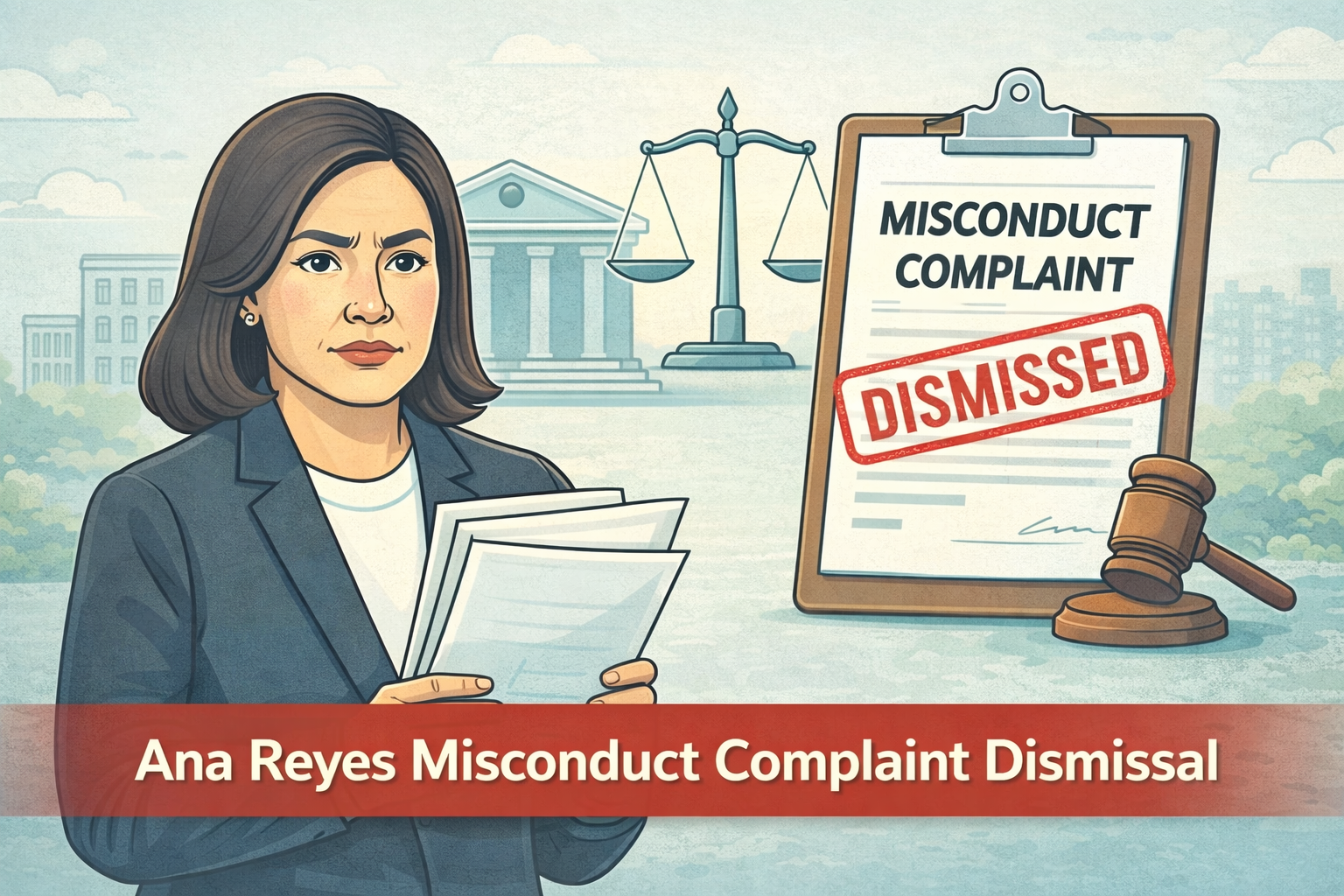
In more than two centuries of American legal history, it has been exceedingly rare for the U.S. Department of Justice to file a formal misconduct complaint against a sitting federal judge. When that extraordinary step was taken in February 2025 targeting U.S. District Judge Ana Reyes of the District of Columbia it immediately drew national attention, igniting a fierce debate about judicial independence, executive overreach, and the limits of appropriate courtroom conduct.
DOJ complaint against Judge Ana Reyes was filed on February 21, 2025. Eight months later, on September 29, 2025, Chief Judge Sri Srinivasan of the U.S. Court of Appeals for the D.C. Circuit issued his ruling and the complaint was dismissed in full. The order was not made public until November 25, 2025, and its reasoning carries significant implications for how the executive branch may and may not interact with the federal judiciary going forward.
| 📋 Case Summary
The U.S. Department of Justice’s complaint against a judge was dismissed on September 29, 2025 by Chief Judge Sri Srinivasan of the D.C. Circuit. The dismissal was procedural in nature and made no finding on the merits of the underlying allegations. |
This article explains who Judge Ana Reyes is, what triggered the complaint, what specific allegations were made, exactly why the complaint was dismissed, and what the outcome means for the ongoing tension between the Trump administration and the federal judiciary.
1. Who Is Judge Ana Reyes?
Ana Cecilia Reyes was born in 1974 in Montevideo, Uruguay. She immigrated to the United States as a child and eventually settled in Louisville, Kentucky, where she learned English as a first-grade student a journey that came full circle in 2020 when she was reunited with that same teacher after more than four decades apart, a story that went widely viral.
Reyes graduated summa cum laude from Transylvania University in 1996 and went on to build a distinguished legal career in Washington, D.C. In 2023, President Joe Biden nominated her to the United States District Court for the District of Columbia and her Senate confirmation made history: she became both the first Latina and the first openly LGBTQ+ person to serve as a federal district judge in Washington, D.C.
Before the misconduct complaint brought her into the national spotlight, Reyes was already known for a sharp and intellectually demanding courtroom style. She presided over a major DOJ antitrust case involving Assa Abloy in 2023 and, in January 2024, sentenced Charles Littlejohn who had leaked former President Trump’s tax returns to journalists to five years in prison, the statutory maximum.
| ⚖ Judge Profile — Key Facts
Appointed by President Biden in 2023. First Latina and first openly LGBTQ+ federal judge in Washington D.C. Born in Montevideo, Uruguay in 1974. Known for an active, probing courtroom style and rigorous approach to complex federal litigation. |
2. The Case That Triggered the Complaint: Transgender Military Ban
The chain of events leading to the misconduct complaint began in January 2025, when President Trump signed Executive Order 14183 directing the U.S. military to bar transgender individuals from service. The order stated, without providing evidentiary support, that transgender service members presented a conflict with a commitment to an ‘honorable, truthful, and disciplined lifestyle.’
Six active-duty transgender service members and two applicants filed a federal lawsuit challenging the order. The case landed in Judge Reyes’s courtroom. In February 2025, she presided over hearings on a preliminary injunction an emergency order that would block the ban while the litigation proceeded.
The hearings were intense. Reyes questioned DOJ attorneys vigorously and at times sharply, pressing hard on the administration’s legal justifications. Two specific exchanges during those hearings became the foundation of what followed. In March 2025, Reyes issued her ruling blocking enforcement of the executive order, finding it likely violated the constitutional rights of the plaintiffs. She later agreed to suspend her order pending the government’s appeal and the U.S. Supreme Court separately allowed the administration to implement the ban in the interim while appeals continued.
3. The DOJ Complaint: What Were the Specific Allegations?
The DOJ complaint against Judge Ana Reyes was submitted by Chad Mizelle, then-chief of staff to Attorney General Pam Bondi, who has since departed the department. Filed on February 21, 2025 before Reyes had even issued her ruling the complaint alleged that she had displayed ‘hostile and egregious misconduct’ during the February hearings and that her behavior ‘compromised the dignity of the proceedings and demonstrated potential bias.’
Two specific courtroom incidents formed the core of the allegations:
- The Religious Question: During the hearing, Reyes asked a DOJ attorney: ‘What do you think Jesus would say to telling a group of people that they are so worthless that we’re not going to allow them into homeless shelters?’ The attorney declined to speculate. Mizelle’s complaint argued that invoking religion in this manner was inappropriate judicial conduct that signaled ideological bias.
- The University of Virginia Analogy: To illustrate the logical structure of categorically branding a group as dishonest, Reyes described a hypothetical in which she would ban all University of Virginia law graduates from her courtroom because they were all ‘liars who lack integrity.’ She then asked a DOJ attorney a UVA graduate to sit down and then called him back to the podium. The complaint argued this was a deliberate attempt to embarrass counsel and constituted misconduct.
The timing of the filing before any ruling had been issued was itself widely noted as extraordinary. Misconduct complaints filed by active litigants against the judge presiding over their own case are exceedingly rare in American federal practice, and many legal scholars immediately questioned whether the mechanism was being used appropriately.
4. Ana Reyes Misconduct Complaint Dismissal: The Full Legal Reasoning
Chief Judge Sri Srinivasan issued his dismissal order on September 29, 2025. His reasoning was procedural, precise, and significant and it did not require reaching any conclusion about whether Reyes’s courtroom behavior was appropriate or inappropriate.
The U.S. Department of Justice’s complaint against a judge was dismissed on a foundational procedural ground: a misconduct complaint is not the correct legal mechanism for a litigating party to challenge a judge’s impartiality or seek her disqualification from a case. The established and designated procedure for that purpose is a recusal motion a formal request, filed within the pending case, asking the judge to step aside.
The DOJ had not filed a recusal motion at any point. It had not explicitly asked for Reyes to be removed from the transgender troops case. By filing a misconduct complaint while bypassing the available recusal procedure, the department had used the wrong tool for the concern it claimed to have.
| 📌 Chief Judge Srinivasan’s Key Finding
The dismissal order stated that a misconduct proceeding ‘is not meant to function as an alternate means by which a party in a pending case could bring about the judge’s recusal.’ This principle is essential to protecting judicial independence from being undermined through procedural misuse. |
Critically, the dismissal was not an exoneration of Reyes. It was not a finding that her conduct was appropriate. It was a determination that the misconduct complaint mechanism regardless of the underlying facts was not the right forum for the DOJ’s stated concerns. The DOJ neither appealed this ruling nor filed the recusal motion that the chief judge’s reasoning implicitly indicated was the proper path.
5. The Broader Context: Executive Branch vs. Federal Judiciary in 2025
This case did not exist in isolation. The DOJ filed two judicial misconduct complaints against federal judges in 2025 both in the D.C. District Court, both in cases involving challenges to Trump administration executive orders, and both ultimately dismissed. The other complaint targeted U.S. District Judge James Boasberg and was dismissed on similar grounds.
The filings occurred against a backdrop of escalating friction between the Trump administration and the Article III judiciary. Senior DOJ officials publicly described the situation as a ‘war’ and criticized what they characterized as ‘rogue activist judges.’ Calls for judicial impeachment were made by administration allies, though constitutional scholars noted the high legal threshold such proceedings require.
- Both 2025 DOJ misconduct complaints against federal judges were dismissed
- Neither complaint produced a finding of misconduct on the merits
- Neither judge was removed from their respective cases
- The DOJ appealed neither dismissal and pursued no recusal petition in either matter
- The underlying constitutional litigation including the transgender military ban continues through the normal appellate process
6. What This Ruling Means for Judicial Independence
The dismissal carries implications that reach far beyond Judge Reyes or the transgender military ban. At its core, it is an affirmation that parties in federal litigation including the United States government itself must use designated procedural tools to address concerns about judicial conduct. Misconduct proceedings cannot be substituted for recusal motions, and that boundary protects the integrity of the federal judiciary as a whole.
For everyday readers following U.S. legal news, the practical meaning is clear: the system of institutional checks designed to insulate federal judges from political pressure functioned as it was designed to. A chief judge reviewed the complaint through established channels and applied the law consistently, without regard to the political sensitivity of the underlying dispute.
The constitutional questions at the heart of the transgender military ban case remain unresolved as of early 2026. The federal appeals process continues, the Supreme Court has permitted enforcement in the interim, and the courts have not yet issued a final ruling on the merits. The legal story is far from finished even if the misconduct complaint chapter is firmly closed.
Quick-Reference: Key Facts at a Glance
- Judge Ana Reyes — U.S. District Court for D.C., appointed by President Biden in 2023
- First Latina and first openly LGBTQ+ federal judge in Washington D.C.
- February 21, 2025 — DOJ filed misconduct complaint alleging ‘hostile and egregious’ conduct
- Filed by Chad Mizelle, then-chief of staff to AG Pam Bondi (since left the DOJ)
- Two allegations: inappropriate religious question + UVA law analogy used in court
- March 2025 — Reyes blocked Trump’s transgender military ban; ruling later suspended on appeal
- September 29, 2025 — Chief Judge Srinivasan dismissed the complaint on procedural grounds
- Reason: misconduct complaint is not a substitute for a recusal motion
- No finding made on the merits — dismissal is not an exoneration
- DOJ filed no appeal and no recusal petition following the dismissal
Ana Reyes Misconduct Complaint Dismissal: What It Tells Us
The Ana Reyes Misconduct Complaint Dismissal is now a closed procedural chapter but the story it sits inside is still being written. The complaint was dismissed. No misconduct was found on the merits. The judge remains on the bench. No further action was pursued by the government. By every formal measure, a highly unusual situation was resolved through entirely ordinary legal process and that, legal scholars argue, is exactly what a functioning constitutional system looks like.
The deeper questions the case raised, however, remain very much open. Where is the boundary between rigorous judicial questioning and conduct that compromises the appearance of impartiality? What are the legitimate limits if any on the executive branch’s use of the misconduct complaint system against judges actively presiding over cases brought by that same executive branch? And what does the pattern of 2025’s judicial complaint filings tell us about how the relationship between the executive and judicial branches is evolving?
These are not theoretical questions. They sit at the intersection of constitutional law, democratic governance, and the day-to-day administration of justice for millions of Americans. The Reyes case did not answer them but it placed them, clearly and unavoidably, on the table.