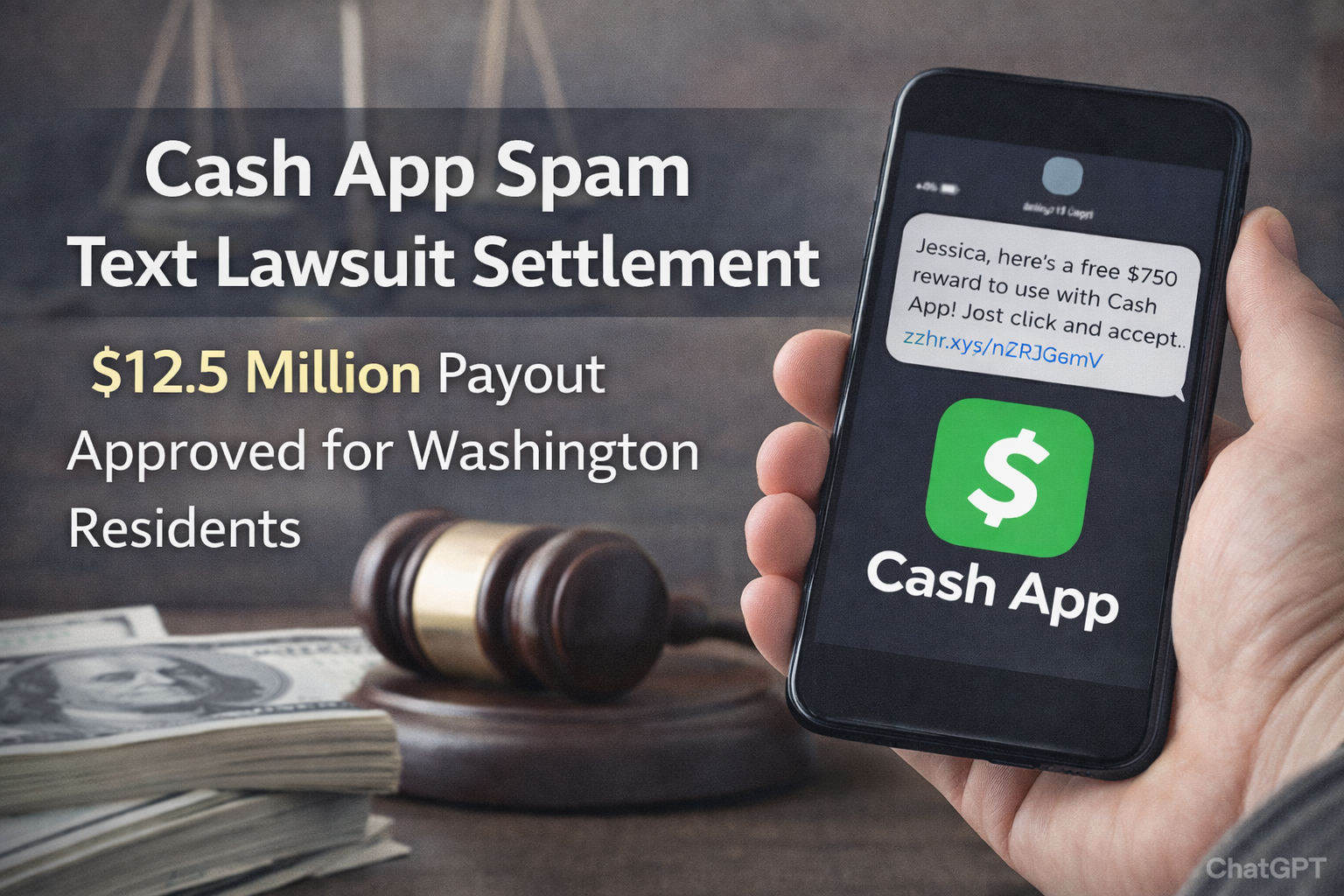
Have you ever received a random text message from Cash App that you never asked for? You’re not alone. Millions of people across Washington state have received unsolicited text messages encouraging them to download Cash App through the app’s “Invite Friends” referral program. Now, there’s good news: a massive $12.5 million Cash App Spam Text Lawsuit Settlement has been approved to compensate affected consumers. This settlement represents a significant victory for consumer privacy rights and highlights the importance of consent-based marketing. If you’re a Washington resident who received these unwanted spam texts, you could be entitled to a payment between $88 and $147 through this settlement.
Understanding the Problem: Why Did People Receive These Texts?
Cash App, owned by Block, Inc., is one of the most popular mobile payment services in America. Millions of people use it daily to send money to friends and family, pay bills, and make purchases through the Cash Card. Like many apps, Cash App wanted to grow its user base, so the company created an “Invite Friends” referral program. On the surface, this seemed like a reasonable marketing strategy. Cash App users could click a button to invite their contacts to download the app, and both the inviter and invitee would receive a $5 bonus.
However, here’s where the problem began: Cash App’s system allowed users to send pre-generated text messages to their phone contacts automatically. The messages included language like: “Hey! I’ve been using Cash App to send money and spend using the Cash Card. Try it using my code and you’ll get $5. FVRJ1PH · FVRJ1PH.” The issue wasn’t with Cash App users who intentionally sent these referral texts. The real problem was with the recipients—people who received these messages without ever asking for them or giving permission. These were unwanted marketing texts, spam that cluttered phones and inboxes without consent. Many recipients found these messages confusing because they didn’t understand why they were receiving promotional content, which eventually led to the Cash App Spam Text Lawsuit Settlement.
Key Facts About the Settlement
| Key Information | Details |
| Settlement Amount | $12.5$ million total from Block, Inc. (Cash App’s parent company) |
| When Established | Proposed settlement filed June 30, 2025; Preliminary approval July 29, 2025; Final approval December 2, 2025 |
| Who Is Affected | Washington residents who received Invite Friends text messages between Nov 14, 2019 and Aug 7, 2025 |
| Who Filed the Case | Lead plaintiff Kimberly Bottoms filed lawsuit against Block, Inc. (Case No. 2:23-cv-01969-MJP) |
| Judge Approval | Judge Marsha J. Pechman (preliminary), Judge John Chun (final approval) |
| Current Status (2026) | Final approval granted; Distribution of payments beginning; Settlement administrator processing claims |
| Payment Per Person | Estimated $88–$147 per eligible claimant (exact amount depends on number of valid claims) |
| Claims Deadline | October 27, 2025 (deadline has passed; claim window closed) |
Who Brought This Lawsuit and Why?
The case is officially known as Bottoms v. Block, Inc. The lead plaintiff, Kimberly Bottoms, received unsolicited text messages from Cash App’s Invite Friends feature. According to her complaint, she “did not understand why she was receiving annoying and harassing spam texts, which are a nuisance.” Bottoms filed the lawsuit in Washington state court in November 2023, arguing that Cash App violated state consumer protection laws.
The legal basis for her claim centered on Washington’s Commercial Electronic Mail Act (CEMA), which has strict rules about sending marketing messages. Washington law specifically prohibits companies from sending unsolicited commercial text messages to state residents. Importantly, the law doesn’t just apply to the company that owns the app it also applies to anyone who “initiates or assists” in transmitting these unwanted messages. This is a critical point because it means Cash App wasn’t just liable for the messages it sent directly; it was also potentially liable for assisting users in sending referral texts without the recipients’ consent. This legal pressure eventually paved the way for the Cash App Spam Text Lawsuit Settlement.
Block’s Response: Denying Wrongdoing but Settling
Block, Inc. denied any wrongdoing, arguing it complied with all laws and that users initiated referral messages, not Cash App. However, Block decided to settle rather than continue litigation. A $12.5 million settlement likely proved more cost-effective than extended court battles, attorney fees, and reputational damage. Importantly, Block did not admit wrongdoing a common settlement arrangement.
The Cash App Settlement Class Action Explained
Understanding who qualifies for settlement payments is crucial. This settlement is specific not open to all Cash App account holders. To be eligible, you must: (1) Have received one or more referral text messages between November 14, 2019 and August 7, 2025; (2) Been a Washington resident when you received messages; (3) Not clearly consented in advance to receive the text. The Cash App Spam Text Lawsuit Settlement covers approximately 1.97 million Washington residents. However, only about 5% of eligible class members are estimated to file claims, resulting in individual payments in the $88–$147 range.
How Much Money Will You Receive?
The cash app $147 settlement figure refers to the maximum estimated payout. The exact amount depends on several factors. From the $12.5 million total, attorney fees of $3.1 million, class representative award of $10,000, and administrative costs are deducted. The remaining approximately $8.7 million is divided equally among eligible claimants. If 100,000 people filed claims, each would receive about $87. If only 50,000 filed, each would receive about $174. This explains the $88–$147 range for the Cash App Spam Text Lawsuit Settlement.
The Broader Impact: What This Settlement Means
The Cash App settlement is significant beyond the $12.5 million payout. It establishes legal precedent about consumer privacy and how companies handle marketing messages. If a company’s system facilitates unsolicited commercial messages, the company bears responsibility under state consumer protection laws. For Washington residents, it confirms that consumer protection laws have real teeth and companies cannot treat phones as marketing billboards.
What Happens Now: Payment Timeline
Final approval was granted on December 2, 2025, by Judge John Chun, who determined the settlement was “fair, reasonable, and adequate.” With final approval in place, the settlement administrator (EisnerAmper) began processing verified claims. For people who submitted valid claims by the October 27 deadline, payments are expected to begin in early 2026. The administrator will verify each claim against Block’s records of Invite Friends texts. Once approved, payments will be distributed through direct deposit, mailed check, or electronic transfer. The entire process is estimated to take several months, with most claimants receiving funds between February and June 2026.
The Larger Picture: Class Action Lawsuits Protecting Consumers
The Cash App lawsuit exemplifies how class action litigation protects consumer rights when individual harm is too small for anyone to sue alone. A single person’s $2.50 loss wouldn’t justify legal action, but 1.97 million people receiving unwanted texts creates collective harm worth $12.5 million. The settlement clarifies that consent still matters in digital contexts, ensuring companies take responsibility for systems generating marketing messages without proper authorization.
Conclusion
Cash App spam text lawsuit settlement represents a meaningful victory for consumer privacy. A $12.5 million payout, with individual payments estimated between $88 and $147, compensates Washington residents who received unsolicited marketing texts. More importantly, the settlement establishes that companies like Block must take responsibility for systems that generate marketing messages without proper consent. As digital marketing continues evolving, settlements like this one ensure that consumer rights remain protected. If you received Cash App referral texts while living in Washington and haven’t already claimed your settlement payment, you may have missed the October 2025 deadline, but you should monitor official settlement communications for any updates about claim periods or appeals.
Disclaimer: This article is based on publicly available court documents and settlement information as of February 2026. It is for informational purposes only and does not constitute legal advice.