 By David Silson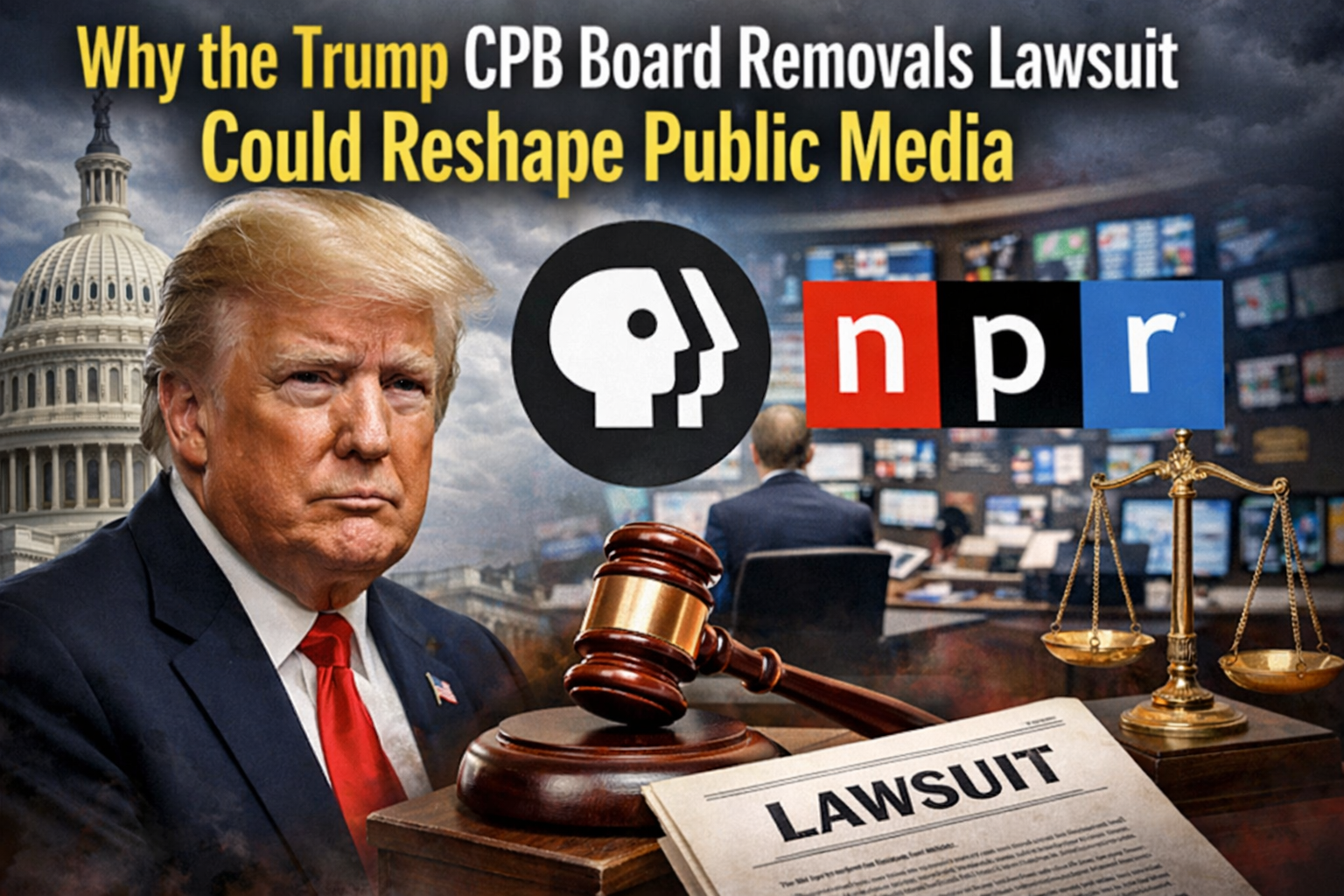
Key Takeaway for Readers
If you watch PBS, listen to public radio, or rely on your local public station for news or emergency alerts, here is what you need to know right now.
- Your local public station’s situation depends heavily on where you live. Stations in major cities with strong donor bases are in a much better position than small rural stations that ran primarily on CPB grants. Check your local station’s website for updates on their funding situation.
- Donating directly to your local station is the most immediate thing you can do. Because CPB distributed money to individual stations — not to PBS or NPR as organizations your local station is the entity that most directly needs support. PBS and NPR memberships help, but your community station matters most.
- The court cases are ongoing. The constitutional fight over whether a president can remove CPB board members has not been finally decided. But even a court victory for CPB will not restore the $1.07 billion Congress voted to rescind. Those are two separate battles.
- Some states are exploring state-level funding alternatives. If you care about keeping your local public station on the air, contacting your state legislators is a practical step state governments have the authority to step in where federal funding has been cut.
- Emergency alerts and rural news coverage are at the greatest risk. If you live in a remote area where public radio is your primary source of local news or emergency information, your station is likely among the most financially vulnerable. Act early.
On the night of April 28, 2025, three members of the board of the Corporation for Public Broadcasting received a short, blunt email from the White House. No phone call. No formal meeting. Just a message saying their positions were “terminated effective immediately, on behalf of President Donald J. Trump.”
By the next morning, lawyers were in federal court. Within days, a judge had temporarily blocked the firings. Within weeks, Congress was being asked to pull back more than a billion dollars of funding already approved for public broadcasting. And by early 2026, CPB the quiet financial engine behind PBS, NPR, and more than 1,500 local public stations across America was effectively shutting down.
This article walks through the whole story in plain language. Whether you first heard about this through a news headline or searched specifically for the Trump CPB board removals lawsuit, here is everything you need to know following the exact questions most people are asking.
What Is the Corporation for Public Broadcasting?
Most people who watch PBS or listen to NPR have never heard of the Corporation for Public Broadcasting. That is by design. CPB works quietly in the background, and that is exactly how Congress intended it to work.
Congress created the Corporation for Public Broadcasting in 1967, during the Lyndon B. Johnson administration, through the Public Broadcasting Act. The idea was simple: commercial TV and radio are driven by advertisers, which means they chase big audiences and often ignore smaller communities, rural areas, and topics that don’t make money. Public broadcasting would fill that gap.
CPB is not a TV channel or a radio network. It does not produce shows. What it does is distribute federal money around $535 million per year to more than 1,500 public radio and television stations across the country. Over 70% of that money goes directly to local stations as grants. PBS and NPR receive portions as well, but CPB is not their only source of income.
For small rural stations in places like Alaska, Appalachia, Native American territories, and the Great Plains, CPB grants were often the difference between staying on the air and going dark. These are places where commercial media has no financial reason to operate, where public radio is the only local news outlet, and where emergency alerts from public stations are sometimes the only way residents learn about disasters, floods, or wildfires.
Key fact: CPB does not make TV shows or radio programs. It funds the 1,500+ stations that do.
Critically, Congress set CPB up as a private, nonprofit corporation not a government agency. The 1967 law explicitly says CPB must be free from any “direction, supervision, or control” by government officers. The President nominates board members and the Senate confirms them, but once confirmed, those board members are not government employees and do not answer to the White House. This structure was intentional: Congress wanted public broadcasting to be insulated from political pressure, no matter who was in the Oval Office. That independence is precisely what sits at the heart of the Trump CPB board removals lawsuit.
What Did Trump Do, and Why?
On April 28, 2025, a White House official named Trent Morse a deputy director of presidential personnel sent termination emails to three CPB board members: Laura G. Ross, Thomas E. Rothman, and Diane Kaplan. All three had been nominated to their positions by President Biden.
The email read, in its entirety: “On behalf of President Donald J. Trump, I am writing to inform you that your position on the Corporation for Public Broadcasting is terminated effective immediately. Thank you for your service.”
No legal authority was cited. No reason was given. No formal process was followed.
The board firings did not happen in isolation. They were part of a broader campaign against CPB, PBS, and NPR that unfolded over several months.
The Executive Order
Just three days later, on May 1, 2025, President Trump signed an executive order instructing CPB to immediately stop sending any federal funding to NPR and PBS. Trump and his allies had long accused both organizations of having a liberal bias. On social media, Trump called NPR and PBS “monsters” and described their content as “woke propaganda.” He wrote that they had “zero tolerance for non-leftist viewpoints.”
“NPR and PBS are a Radical Left Disaster, and 1000% against the Republican Party!” President Trump on Truth Social, June 2025
CPB publicly refused to follow the order. Its leadership argued correctly, under the 1967 law that the President has no authority to tell CPB how to spend congressionally appropriated money. CPB continued distributing grants to both networks.
The Attempt to Rescind the Funding
With CPB refusing the executive order, the Trump administration turned to Congress. In late May 2025, Trump formally requested that Congress take back or “rescind” $1.1 billion in public broadcasting funding that Congress had already approved for fiscal years 2026 and 2027. Congress funds CPB two years in advance precisely to give public stations financial stability and protect them from year-to-year political battles.
The House passed the rescission bill by a margin of 214 to 212 four Republicans voted against it. In the Senate, Republican Senators Lisa Murkowski of Alaska and Susan Collins of Maine voted with Democrats in opposition, but it was not enough. The bill passed. On July 24, 2025, the Rescissions Act of 2025 became law. CPB lost $1.07 billion in already-approved funding overnight.
DOGE Tried to Move In
The day after the board firings, staffers from the Department of Government Efficiency the informal DOGE office associated with Elon Musk emailed CPB requesting access to embed a review team inside the organization. CPB’s general counsel sent back a flat refusal, citing the same legal independence that made the board firings illegal. Federal agencies have no supervisory role over CPB, full stop.
Who Filed the Lawsuit, and What Are They Arguing?
Three separate lawsuits were filed in response to Trump’s actions against CPB.
Lawsuit #1: CPB vs. Trump
On April 29, 2025 less than 24 hours after the termination emails went out the Corporation for Public Broadcasting itself filed a lawsuit in the U.S. District Court for Washington, D.C. The defendants named were President Trump, White House officials, and the Office of Management and Budget.
CPB’s argument was straightforward: the President cannot fire CPB board members because the law that created CPB does not give him that power. The 1967 Public Broadcasting Act has only one mechanism for removing a board member missing too many meetings. There is no presidential removal clause. Board members are not federal employees. They do not serve at the president’s pleasure. Therefore, the termination emails were legally meaningless, and the board members were still on the board.
CPB also pointed to what had happened weeks earlier with the U.S. Institute of Peace another congressionally created independent nonprofit. The Trump administration had removed its board, seized its building, and dismantled the institution. CPB’s lawyers argued the same playbook was being run against them, and that courts needed to step in before the same thing happened.
Case name: Corp. for Public Broadcasting v. Trump, U.S. District Court, D.C., No. 1:25-cv-01305
Lawsuit #2: PBS vs. Trump
On May 30, 2025, PBS and a Minnesota member station filed their own separate lawsuit against the Trump administration, specifically challenging the executive order directing CPB to cut off their funding. PBS argued the executive order violated the First Amendment, congressional authority over appropriations, and the same legal independence protections that CPB had cited. Their case argued that cutting public broadcasting funding based on the government’s disagreement with editorial content is unconstitutional viewpoint discrimination.
Lawsuit #3: NPR vs. CPB (and Then a Settlement)
A third legal fight was smaller but revealing. In April 2025, CPB’s board had approved a renewal of a $36 million grant to NPR to operate the Public Radio Satellite System the infrastructure that allows hundreds of stations to share programming nationwide, a system NPR has run since 1985. Under pressure from the White House, CPB reversed that decision the very next day after a top White House budget official expressed her “intense dislike for NPR.” CPB redirected the money to an entity that did not even exist yet.
NPR sued CPB over it. In November 2025, the two organizations reached a settlement: CPB agreed to restore the $36 million satellite grant, and NPR dropped its specific claims about the contract. The broader lawsuit challenging Trump’s executive order continued.
Trump Counter-Sues the Board Members
In July 2025, the administration filed its own lawsuit directly against the three individual board members, Laura Ross, Tom Rothman, and Diane Kaplan asking the court to affirm that the president had the power to remove them. The White House argued that the Constitution’s executive power provisions give the president broad authority to remove anyone exercising authority funded by the federal government. CPB’s lawyers countered that running a private nonprofit is not the same as exercising executive authority over government operations.
What Have the Courts Said So Far?
Federal judge Randolph D. Moss, of the U.S. District Court in Washington D.C., has been the central figure in these cases. He was assigned both CPB’s original lawsuit against Trump and the administration’s counter-lawsuit against the board members.
On April 29, 2025 the same day CPB filed its lawsuit Judge Moss held an emergency hearing and issued a temporary restraining order blocking the White House from enforcing the board member dismissals. The three fired board members remained on the board.
That temporary block was a significant early signal. A judge does not issue an emergency restraining order unless they find that the party seeking it has a reasonable chance of winning on the merits. Georgetown law professor Stephen Vladeck noted at the time that CPB’s legal argument “has legs,” meaning it is a serious case that courts are likely to engage with carefully.
However, the court victory was limited in practical impact. The board members kept their seats but Congress still voted to strip CPB’s funding in July. The courts can protect the board from being fired, but they cannot force Congress to restore money it has voted to rescind. Those are two separate battles, and the funding battle was lost in the legislative branch, not the judicial one.
As of early 2026, no final ruling had been issued on the core constitutional question: whether the president has the power to remove CPB board members. Both the original Trump CPB board removals lawsuit and the administration’s counter-lawsuit against the three board members were still working through the court system before Judge Moss.
“The Trump administration is not trying to win all these lawsuits. A lot of its behavior is designed to intimidate, to chill, to shift the conversation, to consume the oxygen.” Georgetown law professor Stephen Vladeck
What Happens to PBS and NPR If CPB Loses Funding?
This is the question that matters most for everyday Americans and the honest answer is that the damage is already happening, regardless of how the courts ultimately rule.
PBS Cut 21% of Its Budget
In August 2025, PBS announced it was cutting 21% of its annual budget. It laid off staff and began scaling back programming development. PBS CEO Paula Kerger said the cuts would affect the organization’s ability to create new content and support its member stations around the country. Shows like Frontline, Nova, and educational children’s programming face a more uncertain future.
78 NPR Stations Face Serious Risk
NPR president Katherine Maher stated that 78 member stations were at immediate risk of not being able to continue normal operations after the federal funding cut. Roughly half of all NPR member stations, she said, would need to make “significant adaptations” to stay on the air. The stations most at risk are not the large city stations in New York or Los Angeles those have strong donor bases and corporate underwriters. The most vulnerable stations are in rural areas, Native American communities, and economically underserved regions where private sponsorship money simply does not exist in meaningful amounts.
CPB Itself Is Winding Down
By early 2026, CPB was operating with a skeleton crew and beginning the process of shutting down after nearly 60 years of distributing federal money to public stations. The organization that had been the backbone of American public media since 1967 was ending not with a court order, but with a budget that had been gutted by an act of Congress.
Local Stations Are Scrambling
For many small local stations, losing CPB funding was not losing a small supplementary grant it was losing the core of their operating budget. Some stations launched emergency fundraising drives immediately after the rescission vote passed. Public broadcasting stations reported record individual donations in the weeks that followed, as listeners and viewers rushed to fill the financial gap. Some state governments began discussing whether to step in with state-level funding to keep local stations alive. Whether those emergency measures will be enough to preserve the full breadth of local public broadcasting across all 50 states remains an open question.
What Do Supporters and Critics Say?
Those Who Support Defunding CPB
Republicans backing Trump’s actions argue that taxpayer money should not fund news organizations they believe are politically biased. Senator Ted Cruz of Texas, a vocal supporter of the rescission bill, said public broadcasting had been “overtaken by partisan activists” who push left-wing viewpoints. Supporters also argue that in 2025, when Americans have access to news from hundreds of sources on their phones, the original justification for government-funded broadcasting has weakened significantly.
Representative Marjorie Taylor Greene, who chaired the House subcommittee hearings where PBS and NPR executives testified in March 2025, argued that public broadcasting is an outdated concept from the 1960s and that both organizations should survive if they can on private funding alone. The government should not, in their view, be in the business of subsidizing specific media outlets.
Those Who Oppose the Defunding
Supporters of public broadcasting push back hard on the idea that cutting CPB hurts coastal media elites. They point out that the communities most dependent on public radio and television are often deeply rural and politically conservative places in Alaska, Montana, Wyoming, the Dakotas, and rural Appalachia where public stations are the only local news source, the only emergency alert broadcaster, and sometimes the only radio signal reaching residents at all.
They also argue that the process was improper. Congress had already voted to fund CPB for 2026 and 2027. Rescinding money that had been democratically appropriated simply because the White House disagreed with the editorial content of the organizations being funded — undermines the constitutional principle that Congress, not the president, controls federal spending.
NPR CEO Katherine Maher framed the fight in terms of press freedom: the government, she argued, cannot legally pull funding from a broadcaster specifically because it dislikes that broadcaster’s editorial viewpoint. That is viewpoint discrimination, and the First Amendment prohibits it.
“We seek a clear judgment that finds the illegality and unconstitutionality of this executive order, and, in doing so, establishes definitively that public media enjoys the same protections from viewpoint discrimination as any other entity of the free press.” Katherine Maher, NPR CEO
Frequently Asked Questions
1-Who are the three board members Trump tried to fire?
Laura G. Ross, a finance and nonprofit professional originally appointed to the CPB board by Trump in 2018 and reappointed by Biden. Thomas E. Rothman, chairman and CEO of Sony Pictures Entertainment’s Motion Picture Group. And Diane Kaplan, a longtime public media leader from Alaska. All three refused to leave after receiving the termination email.
2-Can the President actually fire CPB board members?
That is exactly what the courts are being asked to decide. CPB argues clearly that he cannot, because the 1967 law that created CPB does not include any presidential removal mechanism. The Trump administration argues the Constitution’s broad executive power provisions give him that authority regardless. No final court ruling had been issued as of early 2026.
3-What happened to CPB’s $1.07 billion in funding?
Congress voted to rescind it. The House passed the bill 214-212, and the Senate followed. On July 24, 2025, the Rescissions Act of 2025 became law and the money was gone. Courts cannot restore money that Congress has voted to take away — that is a legislative decision, not a judicial one.
4-Are PBS and NPR shutting down?
No, not entirely. But both are significantly cutting back. PBS cut 21% of its budget. NPR said 78 member stations face serious financial risk. The organizations most at risk are small rural and community stations that relied heavily on CPB grants and have limited private fundraising capacity.
5-What was the November 2025 settlement about?
That settlement resolved a specific fight between CPB and NPR over a $36 million satellite distribution contract. CPB had approved the contract, then reversed under White House pressure, then was sued by NPR for it. In November, CPB agreed to restore the contract. NPR dropped its specific claims about the satellite grant. The larger lawsuit about the executive order against NPR and PBS continued separately.
6-Did any Republicans vote against defunding CPB?
Yes. In the House, four Republicans voted against the rescission bill, which is why it passed by only 214-212. In the Senate, Lisa Murkowski of Alaska and Susan Collins of Maine voted with Democrats against it. Both senators represent states where public broadcasting serves large, rural, and remote communities that have few other media options.
7-Where can I follow updates on the Trump CPB board removals lawsuit?
The case is being heard in the U.S. District Court for Washington D.C. before Judge Randolph D. Moss. Court filings are publicly available on PACER. Both NPR and PBS regularly publish updates on their websites regarding the status of the litigation and its impact on their operations.
The day after the board firings, DOGE staffers emailed CPB requesting to embed a review team inside the organization. CPB refused, citing its legal independence from federal oversight. DOGE does not have any formal authority over CPB under the law. The email was widely seen as part of the same broader pressure campaign that included the board firings and the executive order.
The Trump CPB board removals lawsuit will continue working through the courts, and the constitutional questions it raises about presidential power over independent nonprofit institutions are genuinely significant. But the immediate financial reality is already here. CPB is winding down. Local stations are making painful decisions. And the communities that depended most on public broadcasting for news, education, and emergency communication are the ones that will feel it first.
Disclaimer
This article is for informational purposes only and does not constitute legal, political, or financial advice. All information is based on publicly available sources and reflects events as of March 2026. Readers are encouraged to consult qualified professionals for advice specific to their situation.