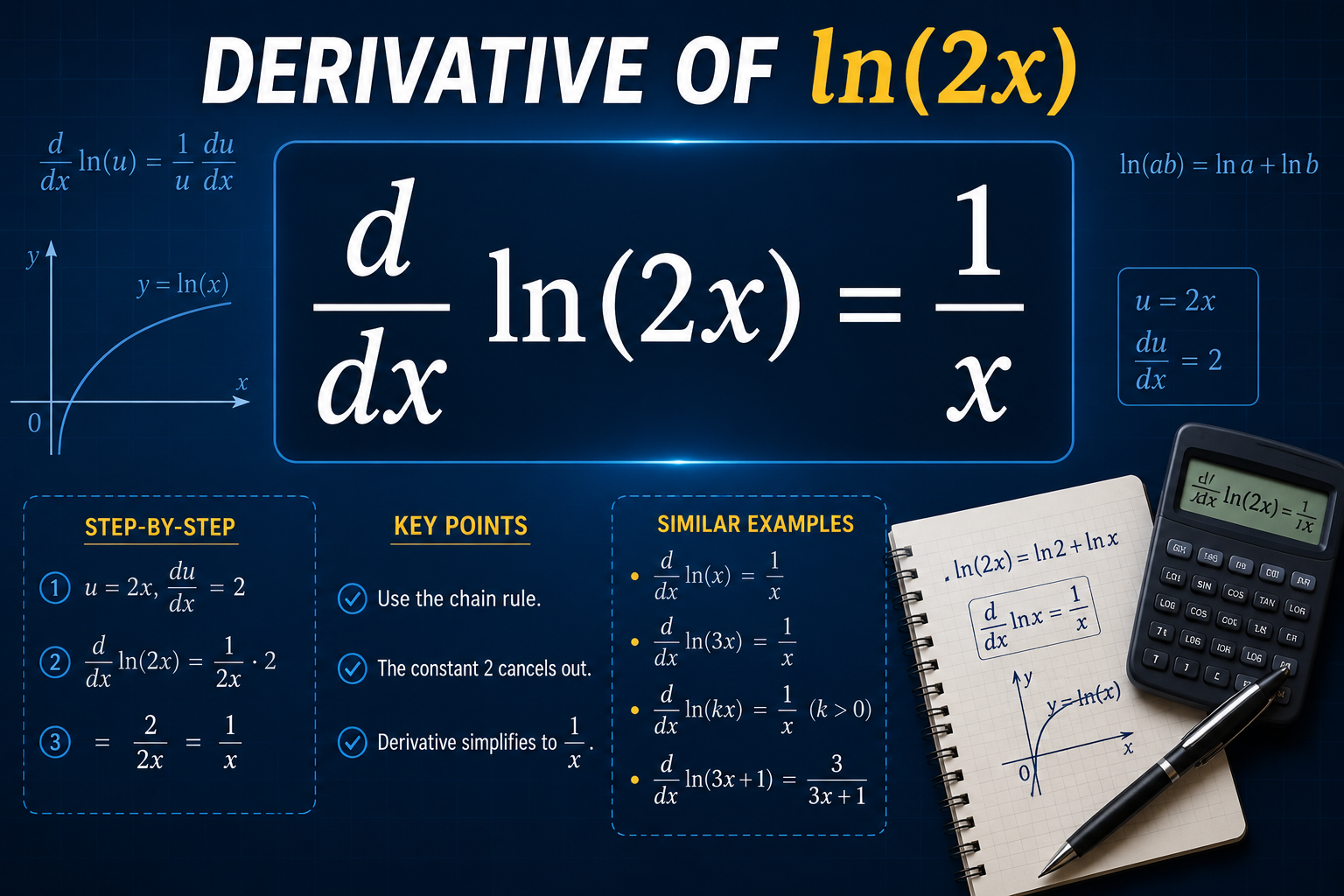
If you’re learning calculus, one common question is derivative of ln(2x). At first glance, the expression may seem more complicated than the derivative of a basic natural logarithm, but the solution becomes straightforward once you apply the chain rule.
Understanding how to differentiate logarithmic functions is essential for solving optimization problems, related rates, curve sketching, and many applications in physics, engineering, economics, and data science. Whether you’re preparing for an exam or simply reviewing calculus concepts, mastering this derivative will strengthen your understanding of logarithmic differentiation.
In this guide, we’ll solve the derivative step by step, explain why it works, compare similar logarithmic functions, and answer common questions.
What Is the Derivative of ln(2x)?
The derivative is:
ddxln(2x)=1x\frac{d}{dx}\ln(2x)=\frac{1}{x}
Although the argument inside the logarithm is 2x, the constant 2 cancels out during differentiation because of the chain rule.
Step-by-Step Solution
Let’s differentiate:
y=ln(2x)y=\ln(2x)
Step 1: Apply the Chain Rule
The derivative of ln(u)\ln(u) is:
1u⋅dudx\frac{1}{u}\cdot\frac{du}{dx}
Here,
u=2xu=2x
Differentiate 2x2x:
dudx=2\frac{du}{dx}=2
Step 2: Substitute Into the Formula
ddxln(2x)=12x×2\frac{d}{dx}\ln(2x)=\frac{1}{2x}\times2
Step 3: Simplify
=22x=\frac{2}{2x} =1x=\frac{1}{x}
Therefore,
ddxln(2x)=1x\boxed{\frac{d}{dx}\ln(2x)=\frac{1}{x}}
Why Doesn’t the 2 Stay in the Answer?
Many students expect the answer to be:
2x\frac{2}{x}
However, the chain rule divides by the inside function 2x2x and then multiplies by its derivative 22.
These two values cancel each other:
12x×2=1x\frac{1}{2x}\times2=\frac{1}{x}
This is why the constant disappears.
Using Logarithm Properties
Another way to solve the problem is by simplifying first.
Using the logarithm identity:
ln(ab)=ln(a)+ln(b)\ln(ab)=\ln(a)+\ln(b)
We get:
ln(2x)=ln2+lnx\ln(2x)=\ln2+\ln x
Since ln2\ln2 is a constant,
ddxln2=0\frac{d}{dx}\ln2=0
and
ddxlnx=1x\frac{d}{dx}\ln x=\frac{1}{x}
So,
ddxln(2x)=1x\boxed{\frac{d}{dx}\ln(2x)=\frac{1}{x}}
Both methods produce the same result.
Read More:how to store flour long term
Comparison Table
| Function | Derivative |
|---|---|
| ln(x)\ln(x) | 1x\frac{1}{x} |
| ln(2x)\ln(2x) | 1x\frac{1}{x} |
| ln(5x)\ln(5x) | 1x\frac{1}{x} |
| ln(7x)\ln(7x) | 1x\frac{1}{x} |
| ln(x2)\ln(x^2) | 2x\frac{2}{x} (for x>0x>0) |
| ln(3x+1)\ln(3x+1) | 33x+1\frac{3}{3x+1} |
Real-World Scenario
Imagine an economist models growth using the equation:
f(x)=ln(2x)f(x)=\ln(2x)
To determine how quickly the value changes over time, they calculate the derivative. The result,
1x,\frac{1}{x},
shows that the rate of change decreases as xx becomes larger, regardless of the constant multiplier inside the logarithm.
My Experience
I’ve found that students understand logarithmic derivatives much faster once they recognize that constant multipliers inside a logarithm often cancel naturally through the chain rule.
Common Mistakes
Avoid these common errors:
- Forgetting to apply the chain rule.
- Writing the answer as 2x\frac{2}{x}.
- Ignoring the derivative of the inner function.
- Forgetting that constants inside logarithms can often simplify.
- Mixing logarithm rules with exponent rules.
Where This Derivative Is Used
The derivative of logarithmic functions appears in many areas, including:
- Calculus courses
- Engineering calculations
- Economics
- Machine learning
- Statistics
- Population growth models
- Physics
- Optimization problems
Learning this rule provides a strong foundation for more advanced differentiation techniques.
Tips for Solving Similar Problems
When differentiating logarithms:
- Identify the inside function first.
- Apply the chain rule carefully.
- Simplify the expression.
- Check whether logarithm identities make the problem easier.
- Verify your final answer.
Frequently Asked Questions
What is the derivative of ln(2x)?
The derivative is:
1x\boxed{\frac{1}{x}}
Why isn’t the answer 2/x?
Because the chain rule produces:
12x×2\frac{1}{2x}\times2
which simplifies to:
1x\frac{1}{x}
Can I simplify ln(2x) first?
Yes. Since:
ln(2x)=ln2+lnx\ln(2x)=\ln2+\ln x
the derivative becomes:
0+1×0+\frac{1}{x}
Does this work for ln(5x)?
Yes. Any positive constant multiplied by xx inside the logarithm gives:
ddxln(kx)=1x\frac{d}{dx}\ln(kx)=\frac{1}{x}
where kk is a positive constant.
Is the chain rule always required?
You can either apply the chain rule directly or simplify using logarithm properties before differentiating.
What is the domain of ln(2x)?
Since the logarithm is defined only for positive values:
2x>02x>0
which means:
x>0x>0
Conclusion
Understanding the derivative of ln(2x) is an important step in mastering logarithmic differentiation. By applying the chain rule—or simplifying the logarithm first—you’ll find that the derivative is simply 1/x. This example demonstrates how constants inside logarithmic functions often cancel during differentiation, making many problems easier than they initially appear.
Once you understand this concept, you’ll be better prepared to solve more advanced logarithmic and exponential calculus problems with confidence.