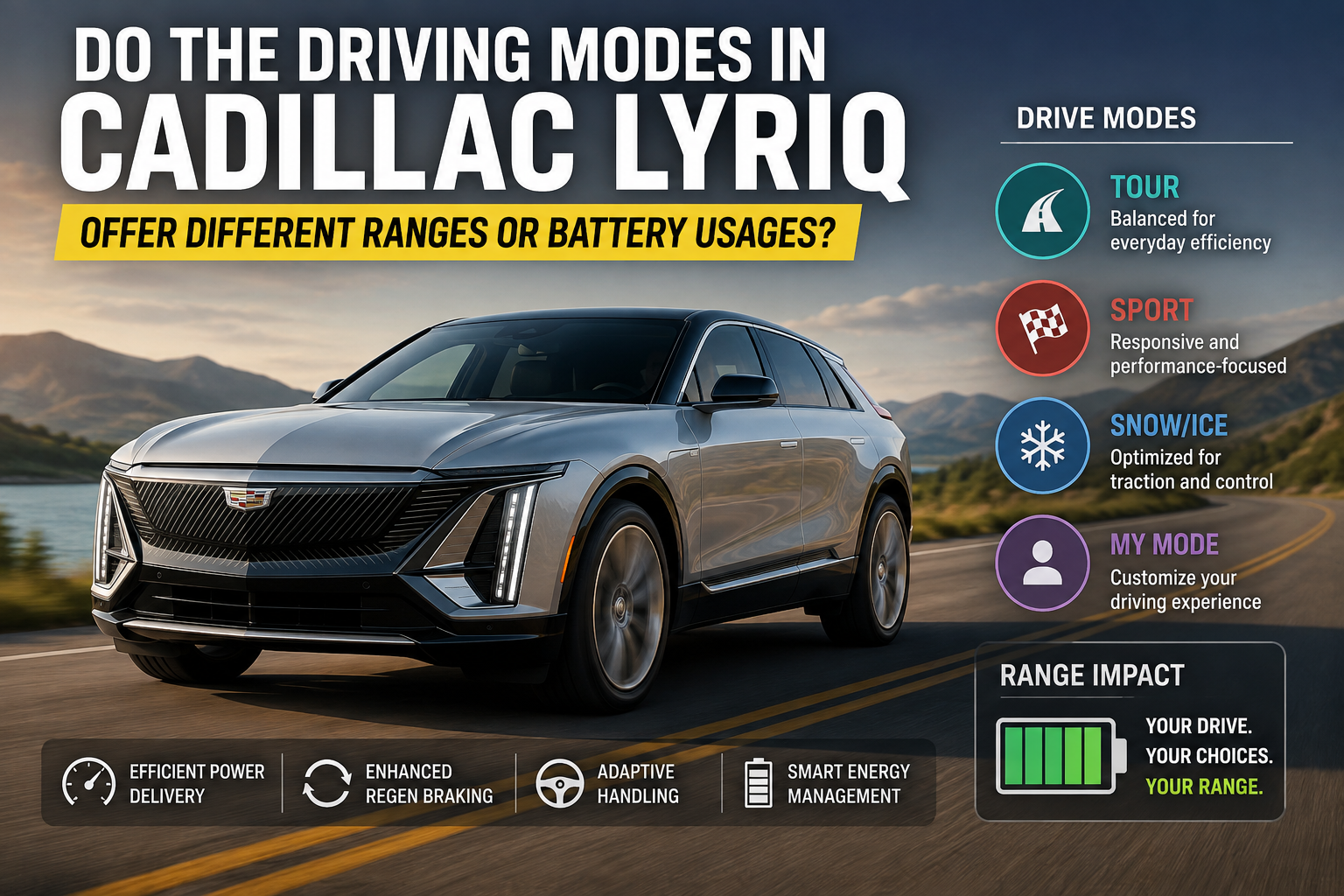
Electric vehicles have changed the way people think about driving, and the Cadillac Lyriq stands out as one of the most refined luxury electric SUVs on the market. Along with its sleek design and advanced technology, it offers multiple driving modes that allow drivers to tailor the vehicle’s behavior to different road conditions and personal preferences.
A common question among prospective buyers and current owners is: do the driving modes in Cadillac Lyriq offer different ranges or battery usages? The short answer is yes but perhaps not in the dramatic way many people expect. Driving modes influence how efficiently the vehicle uses energy, but the actual impact depends far more on driving habits, terrain, weather, and speed than on the selected mode alone.
Let’s take a closer look at how these driving modes work, how they affect efficiency, and what you can realistically expect from your Lyriq’s battery.
Understanding Cadillac Lyriq Driving Modes
The Cadillac Lyriq comes with selectable driving modes designed to change how the vehicle responds to driver inputs. Rather than physically changing the battery itself, these settings adjust software-controlled systems such as:
- Accelerator sensitivity
- Steering feel
- Power delivery
- Regenerative braking behavior
- Traction management
- Stability control settings
Each mode creates a different driving experience while indirectly influencing energy consumption.
Do Driving Modes Actually Change Battery Range?
The answer is yes, but indirectly.
The battery stores the same amount of energy regardless of which mode you choose. However, how efficiently that energy is used varies depending on the vehicle’s response characteristics.
For example, a mode with gentler throttle mapping encourages smoother acceleration, which generally consumes less electricity. On the other hand, a sport-oriented mode allows quicker acceleration and stronger power delivery, which can increase energy usage if driven aggressively.
In other words, the mode influences your driving behavior, and your driving behavior determines the battery’s efficiency.
Read more: FGE 1.6-Cu Ft Over-the-Range Microwave
How Different Modes Affect Energy Consumption
Although available driving modes may vary depending on trim level and software updates, the general effects remain similar.
| Driving Mode | Vehicle Behavior | Typical Energy Impact |
|---|---|---|
| Tour | Balanced comfort and efficiency | Best for everyday driving |
| Sport | Sharper acceleration and steering | Slightly higher battery usage during spirited driving |
| Snow/Ice | Smooth power delivery for traction | Minimal impact unless road conditions require additional energy |
| My Mode (Custom) | Personalized settings | Depends entirely on configuration |
Notice that no mode automatically reduces battery capacity or unlocks additional range. Instead, each setting changes how power is delivered.
Why Sport Mode Often Uses More Battery
Many drivers assume Sport mode continuously drains the battery faster simply because it’s called “Sport.”
In reality, Sport mode doesn’t constantly consume more electricity. It simply makes maximum performance more accessible.
Because acceleration becomes more immediate, drivers often accelerate harder and more frequently. Rapid acceleration requires substantially more electrical power than gradual acceleration.
If two drivers travel the exact same route at identical speeds, with identical acceleration patterns, the energy difference between Tour and Sport modes may be surprisingly small.
The driver’s right foot usually has a much bigger influence than the selected mode.
Tour Mode and Everyday Efficiency
Tour mode is typically the default choice for daily commuting.
It balances:
- Comfortable steering
- Predictable throttle response
- Smooth acceleration
- Stable regenerative braking
These characteristics naturally encourage efficient driving without making the vehicle feel sluggish.
For most owners, Tour mode provides an excellent balance between driving enjoyment and maximizing battery range.
Does Regenerative Braking Change Between Modes?
Regenerative braking plays a significant role in electric vehicle efficiency.
Instead of wasting energy through traditional friction brakes, the electric motors convert kinetic energy back into electricity, sending some of it back into the battery.
Depending on the selected mode and vehicle settings, regenerative braking characteristics may feel slightly different.
However, Cadillac also provides features like One-Pedal Driving, allowing drivers to recover more energy during normal driving regardless of mode.
While regeneration helps improve efficiency, it’s important to understand that it doesn’t create extra electricity—it simply recovers some of the energy that would otherwise be lost.
A Real-World Driving Scenario
Imagine two Lyriq owners driving the same 40-mile commute.
The first driver selects Tour mode, accelerates gradually, anticipates traffic, and makes good use of regenerative braking.
The second driver chooses Sport mode, accelerates aggressively from nearly every traffic light, and brakes hard before intersections.
Even though both vehicles have identical batteries, the first driver is likely to finish the commute with a noticeably higher remaining battery percentage.
This difference comes primarily from driving style rather than the driving mode itself.
Weather and Terrain Often Matter More
Many people focus heavily on driving modes while overlooking factors that have a much larger effect on electric range.
Some of the biggest influences include:
- Highway speeds above 70 mph
- Cold temperatures
- Strong headwinds
- Mountain driving
- Heavy cargo
- Roof-mounted accessories
- Tire pressure
In some situations, these variables can affect range far more than switching between Tour and Sport modes.
For example, driving at 80 mph on a cold winter day can reduce efficiency significantly regardless of which mode is selected.
Battery Management Is Always Working
One misconception is that different driving modes somehow alter battery chemistry or reserve different amounts of energy.
Modern battery management systems continuously monitor:
- Battery temperature
- Voltage
- Charging rate
- Power output
- Cell balancing
- Thermal management
These systems operate independently of driving modes.
Their purpose is to protect battery health while delivering consistent performance throughout the battery’s lifespan.
Can Custom Driving Modes Improve Efficiency?
Some Lyriq configurations allow drivers to customize certain settings.
For example, drivers may prefer:
- Softer steering
- Gentler acceleration
- Increased regenerative braking
- Personalized performance balance
Creating a custom profile can help match the vehicle to your driving preferences while encouraging smoother, more energy-efficient driving.
The key is choosing settings that reduce unnecessary bursts of acceleration without sacrificing comfort.
My Experience Observing EV Efficiency
From my experience comparing different electric vehicles on mixed city and highway routes, I noticed that smooth acceleration and consistent speeds almost always had a greater impact on efficiency than simply changing driving modes.
That observation aligns with how most modern EVs are engineered.
Tips for Maximizing Cadillac Lyriq Range
If getting the most miles from every charge is your priority, consider these habits:
- Accelerate gradually whenever possible.
- Use regenerative braking effectively.
- Maintain recommended tire pressure.
- Avoid carrying unnecessary weight.
- Limit prolonged high-speed driving.
- Precondition the cabin while charging.
- Plan charging stops for longer trips.
- Use climate controls efficiently during extreme weather.
These habits typically provide greater improvements than relying on a specific driving mode alone.
Common Misunderstandings About Driving Modes
Several myths continue circulating among EV owners.
Myth: Sport mode permanently reduces battery life.
Reality: Battery longevity depends much more on charging habits, temperature management, and overall usage than occasional Sport mode driving.
Myth: Tour mode always provides the highest possible range.
Reality: Efficient driving habits matter far more than mode selection.
Myth: Driving modes unlock hidden battery capacity.
Reality: The battery’s usable energy remains essentially the same regardless of mode.
Is There a Noticeable Difference in Everyday Driving?
For most owners, the difference between modes during normal daily use is relatively modest.
If you drive smoothly in any mode, battery consumption may remain quite similar.
However, drivers who frequently enjoy rapid acceleration in Sport mode will likely notice higher energy usage over time.
The important takeaway is that driving modes shape the vehicle’s personality more than they directly determine battery range.
Frequently Asked Questions
Does Sport mode permanently reduce Cadillac Lyriq range?
No. Sport mode does not permanently reduce range. It simply encourages quicker acceleration, which can increase energy consumption if driven aggressively.
Which driving mode is best for maximum efficiency?
Tour mode generally provides the most balanced setup for everyday efficiency, although careful driving habits remain the biggest factor.
Does One-Pedal Driving improve battery efficiency?
Yes. One-Pedal Driving increases regenerative braking opportunities, helping recover energy that would otherwise be lost during deceleration.
Does changing driving modes affect battery health?
No. Driving modes do not directly affect long-term battery health. Proper charging practices and temperature management play much larger roles.
Can driving modes change the battery capacity?
No. The battery capacity remains the same regardless of the selected driving mode. The modes only influence how the available energy is used.
Is the range difference between Tour and Sport mode significant?
For most drivers, the difference is relatively small during normal driving. Aggressive acceleration in Sport mode can reduce efficiency, but smooth driving minimizes the gap.
Conclusion
So, do the driving modes in Cadillac Lyriq offer different ranges or battery usages? Technically, yes—but the effect is indirect. The selected mode changes throttle response, steering characteristics, and overall driving feel rather than altering the battery itself. Because these changes influence how the vehicle is driven, they can affect energy consumption and, ultimately, driving range.
For most drivers, consistent acceleration, effective use of regenerative braking, moderate highway speeds, and good vehicle maintenance will have a much greater impact on efficiency than simply choosing Tour or Sport mode. Understanding how these systems work allows Lyriq owners to enjoy both impressive performance and excellent electric range without compromising everyday comfort.