⚖ Key Findings at a Glance
-
Primary legal claims against Meaningful Beauty center on subscription billing practices, not product efficacy.
-
Federal Trade Commission revised its Endorsement Guides in June 2023, directly raising the bar for celebrity-backed skincare advertising.
-
Modernization of Cosmetics Regulation Act (MoCRA) of 2022 introduced mandatory adverse event reporting, facility registration, and FDA recall authority, all now active.
-
DMDM hydantoin (a formaldehyde-releasing preservative) found in some haircare products has driven industry-wide class-action litigation since the early 2020s.
-
As of May 2026, most Meaningful Beauty disputes resolve through individual BBB settlements; no single class-action verdict has finalized.
Background: Who Is Meaningful Beauty?
Meaningful Beauty is a celebrity-backed skincare brand co-founded by supermodel Cindy Crawford and French anti-aging specialist Dr. Jean-Louis Sebagh. Launched in the early 2000s and popularized through long-form television infomercials, this brand built its identity on the promise of “supermodel skin” through proprietary melon extract complexes and targeted anti-aging formulations.
This brand is distributed primarily through a direct to consumer model, meaning customers order online or by phone and are automatically enrolled in a continuity program. This structure, common to the infomercial era, has become the central flashpoint for the wave of legal complaints that would follow.
Understanding legal challenges surrounding Meaningful Beauty requires separating three distinct threads: how the products are sold (billing and subscription practices), what is inside the products (ingredient safety), and how the products are marketed (advertising claims and endorsement law). Each thread carries its own set of legal risks and regulatory frameworks.
Subscription Billing Controversy: Core Legal Risk
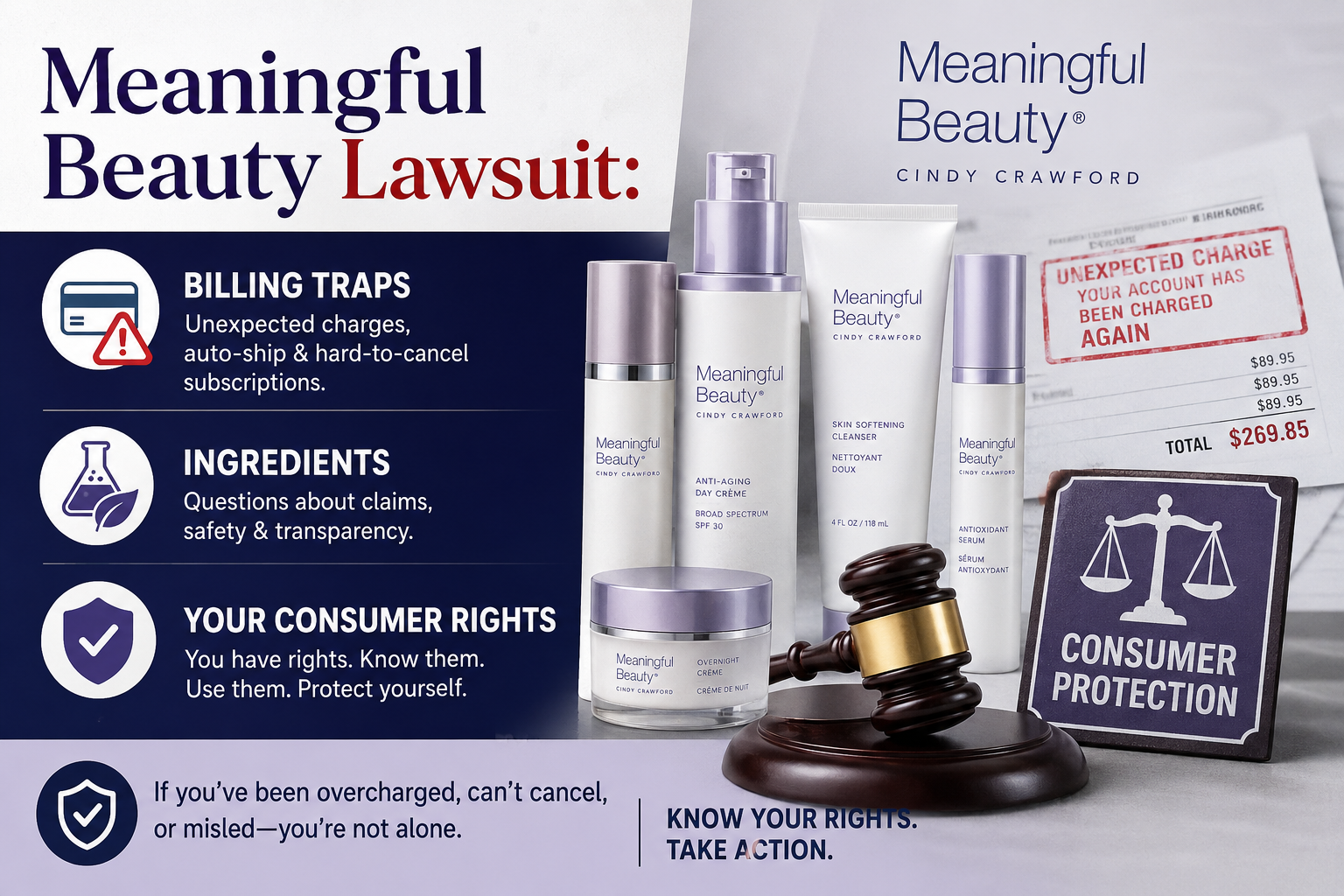
Most documented and persistent legal exposure for Meaningful Beauty does not come from a defective ingredient or a fraudulent clinical claim; it stems from the mechanics of how customers are charged. Across thousands of Better Business Bureau complaints, consumer forum posts, and court filings, a consistent pattern emerges.
“Risk-Free Trial” to Auto-Ship Pipeline
Customers frequently report signing up for an introductory kit advertised as “risk-free” only to discover they have been enrolled in an automatic monthly shipment program. These charges continue until the customer actively cancels, a process that many describe as deliberately difficult.
Specific legal allegations include: burying renewal terms in fine print that is not clearly disclosed at the time of sale; making cancellation contingent on calling a phone number with long hold times rather than enabling an online cancellation option; and continuing to ship and bill customers even after they have attempted to cancel.
⚠ Legal Note
This type of billing structure is commonly referred to as a “negative option” plan where you are enrolled by default unless you take affirmative action to opt out. FTC has brought dozens of enforcement actions against negative option schemes across multiple industries, including beauty, fitness, and food delivery.
As recently as early 2026, BBB records confirm this brand continues to resolve individual disputes regarding unauthorized charges and technical errors that prevent customers from managing their accounts online. While these typically resolve through refunds rather than formal verdicts, cumulative legal pressure on the company is noticeable and regulatory environment is becoming less forgiving by the year.
How This Compares to FTC Enforcement Trends
Meaningful Beauty’s subscription model is not unique, but federal regulators have been dramatically increasing enforcement in this space. In September 2025, FTC secured a landmark $2.5 billion settlement with Amazon over its Prime membership enrollment and cancellation practices, a signal that no company, regardless of size, is immune from scrutiny over subscription tactics. Chegg, an education company, paid $7.5 million in a separate FTC settlement over subscription cancellation barriers in the same period.
For a Meaningful Beauty Lawsuit, risk is not necessarily a single catastrophic event, but a sustained pattern of consumer protection pressure that could compel a court-ordered overhaul of its entire sales infrastructure.
Ingredient Safety: DMDM Hydantoin Question
Separate from billing disputes, some Meaningful Beauty haircare products have been swept into a broader wave of class-action investigations targeting a class of preservatives called formaldehyde-releasers, most prominently, DMDM hydantoin.
What Exactly Is DMDM Hydantoin?
DMDM hydantoin is a preservative used to extend the shelf life of personal care products by slowly releasing small amounts of formaldehyde to inhibit microbial growth. FDA currently classifies it as permissible at low concentrations, and it is found in hundreds of shampoos, conditioners, and skincare formulations across the industry.
However, beginning in the early 2020s, a large number of class-action lawsuits were filed against major haircare brands including OGX, TRESemmé, and others, alleging that these formaldehyde-releasing preservatives caused scalp irritation, allergic reactions, and hair loss in some consumers. Meaningful Beauty’s haircare line was included in several attorney investigations launched during this period.
📋 What to Look For on Labels
If you have sensitive skin or a history of scalp irritation, check ingredient lists for: DMDM Hydantoin, Imidazolidinyl Urea, Diazolidinyl Urea, and Quaternium-15, as all are formaldehyde-releasing preservatives that have been the subject of class-action litigation.
Meaningful Beauty has reformulated some of its products in response to consumer and regulatory pressure. However, consumers who purchased products before reformulation and who experienced adverse reactions may still have standing to participate in ongoing class-action investigations, depending on the jurisdiction and the statute of limitations that applies.
False Advertising & “Supermodel” Standard
Its core marketing proposition that Cindy Crawford’s appearance is the result of using their products has attracted scrutiny from consumer attorneys and regulatory observers alike. Legal framework that governs this is the “Reasonable Consumer” standard.
Under U.S. consumer protection law, advertising is deceptive if it is likely to mislead a reasonable consumer in a material way. Plaintiffs in false advertising cases have argued that featuring Crawford’s image as the central proof of efficacy implies the products are the primary or even sole reason for her appearance, without disclosing the role of genetics, professional cosmetic procedures, lifestyle factors, or the expertise of a personal dermatologist. These are what regulators call “material connections,” facts that would matter to a consumer making a purchasing decision.
“Celebrity pay should be disclosed to inform a disillusioned consumer and protect them from blindly putting faith in a celebrity endorsement.”
Public Comment to FTC on Endorsement Guides Review (FTC.gov)
Legal exposure here is not merely theoretical. In recent years, FTC took enforcement action against principals and celebrity endorsers of a real estate training program, demonstrating a clear willingness to hold named endorsers, not just companies, accountable when advertising crosses the line into deception.
FTC Regulatory Framework: What 2023 Endorsement Guides Mean for Brands Like Meaningful Beauty
In June 2023, Federal Trade Commission finalized an extensive update to its Guides Concerning the Use of Endorsements and Testimonials in Advertising, the first major revision since 2009. These updated guides carry direct implications for celebrity-backed skincare brands.
Gov Source
FTC Endorsement Guides (Revised 2023) Federal Trade Commission finalized updated guidance requiring that all endorsements, including those by celebrities, be truthful and that material connections be clearly and conspicuously disclosed. These guides now include a new formal definition of “clearly and conspicuously” and expanded guidance on influencer and social media endorsements.
Under revised guides, several obligations are now more clearly defined and more vigorously enforced:
“Clearly and conspicuously” standard now has a formal definition: a disclosure must be presented so that consumers are likely to actually notice and understand it, not buried in footnotes or rapid-fire disclaimer text at the end of an infomercial.
Testimonials implying typical results must reflect typical outcomes. If a celebrity endorser achieves her results partly through professional procedures and not solely through the endorsed product, that fact must be disclosed. Omitting it is not a technicality; it is a potential FTC Act violation.
These guides apply across all media including television infomercials, online video, social media posts, and digital advertising. This 2023 revision explicitly expanded the scope to address modern marketing channels that did not exist when guides were last updated.
📌 Practical Impact
For Meaningful Beauty specifically, revised FTC guides mean that any advertisement using Crawford’s appearance as proof of efficacy without disclosing other factors that may contribute to her look now operates in a notably higher-risk regulatory environment than it did even three years ago.
MoCRA: New Federal Cosmetics Law That Changes Everything
Perhaps most consequential long-term legal development affecting Meaningful Beauty and the entire cosmetics industry is not a lawsuit at all. It is a law.
On December 29, 2022, Congress enacted the Modernization of Cosmetics Regulation Act (MoCRA), the first major expansion of FDA authority over cosmetics since 1938. Enforcement began rolling out through 2024 and 2025, and the full weight of its requirements is now active.
Gov Source
FDA on MoCRA Implementation According to FDA, MoCRA provides new authorities including mandatory recall and records access authority. Cosmetics companies must now report serious adverse events to FDA, maintain safety substantiation records, register all manufacturing facilities, and list all marketed products with the agency. FDA has also been instructed to develop regulations for PFAS (forever chemicals) in cosmetics.
What does this mean in practice for brands like Meaningful Beauty?
Mandatory Adverse Event Reporting. If a consumer experiences a serious adverse reaction defined as requiring medical treatment, hospitalization, or involving notable health consequences, this brand must report that event to FDA. This creates a documented record of product safety issues that did not previously exist in this form.
Safety Substantiation on File. Every cosmetic product must be supported by evidence demonstrating a reasonable certainty of safety. Vague claims of “tested by our lab” are no longer sufficient, as FDA now has authority to access these records during inspections.
Mandatory Facility Registration. All domestic and foreign manufacturing facilities must be registered with FDA and renewed biennially. This creates a traceable regulatory footprint for every product sold in the U.S. market.
FDA Recall Authority. For the first time, FDA can mandate a cosmetics recall if it determines a product is adulterated, misbranded, or likely to cause serious adverse health consequences. Previously, recalls were voluntary.
⚖ Why This Matters for Litigation
MoCRA’s adverse event reporting requirement creates a paper trail. If a consumer files a complaint that results in a serious adverse event report, that report becomes part of an FDA-accessible record. In future civil litigation, plaintiff attorneys can potentially use the volume and nature of adverse event reports as evidence of a company’s knowledge of product safety issues.
Comparative Litigation: Where Does Meaningful Beauty Stand?
Context matters. Meaningful Beauty is one of many brands that has faced consumer protection pressure in the beauty and personal care industry during the mid-2020s. This table provides a factual comparison of notable cases and outcomes.
| Brand | Primary Legal Issue | Settlement / Outcome | Status |
| WEN by Chaz Dean | Hair loss & scalp irritation (product formula) | $26.25M settlement | Settled |
| Mario Badescu | Undisclosed prescription steroids in face creams | Class action settlement | Settled |
| Grande Cosmetics | Unapproved drug ingredient (isopropyl cloprostenate) | $6.25M settlement (2024) | Settled |
| TRESemmé / OGX | DMDM hydantoin / hair loss claims | Multiple partial settlements | Largely Settled |
| Meaningful Beauty | Subscription billing; DMDM investigations; ad claims | Individual/BBB refund resolutions | Ongoing |
Meaningful Beauty Lawsuit legal exposure pattern is notably different from brands that faced a single, decisive lawsuit. This brand’s risk is distributed: a continuous stream of billing complaints, ingredient investigations, and advertising scrutiny rather than one landmark case. This pattern, sometimes called “death by a thousand cuts” in consumer protection circles, carries its own form of long-term reputational and financial risk, even without a single large verdict.
What Consumers Should Do Right Now
Whether you are a current subscriber who wants to cancel, a former customer who believes you were overcharged, or someone who experienced an adverse reaction to a product, these following steps represent evidence-based protective actions.
01 Document Everything
Keep records of all purchase confirmations, cancellation attempts, phone call logs (dates and times), and any emails or chat transcripts. This documentation is the backbone of any billing dispute or class-action claim.
02 Dispute Unauthorized Charges
Contact your bank or credit card issuer directly. Most card networks allow chargebacks for unauthorized recurring charges. Act promptly, as chargeback windows are typically 60 to 120 days from the statement date.
03 File a Complaint
Report your experience to FTC at ReportFraud.ftc.gov, the BBB, and your state’s Attorney General’s consumer protection office. Complaints create regulatory pressure that drives enforcement action.
04 Check Your Ingredients
If you experienced scalp or skin issues, identify whether DMDM hydantoin or other formaldehyde-releasing preservatives appear in the product. Photograph the label and save it as documentation for any potential adverse event report.
05 Consult a Consumer Attorney
Many consumer protection attorneys offer free initial consultations for potential class-action participants. If you have documented damages, receipts, medical records, or cancellation records, a consultation can clarify your options.
06 Report Adverse Reactions to FDA
Under MoCRA, you can independently report a serious adverse cosmetic reaction to FDA via the MedWatch program. This contributes to the regulatory record that FDA now actively monitors under the new law.
✦ Bottom Line: A Considered Assessment
Meaningful Beauty is a brand that built an empire on aspirational marketing and a frictionless enrollment model, the same model that now presents its greatest legal liability. Billing practices that generated millions in revenue are precisely the practices under intensifying regulatory scrutiny from FTC, state attorneys general, and consumer protection advocates.
Ingredient concerns (DMDM hydantoin) are real but industry-wide; this brand is one of many caught in a broad reformulation trend rather than a uniquely bad actor in this respect. Advertising claims present a more complex risk, particularly as 2023 FTC Endorsement Guide revisions raise standards for what celebrity-backed brands must disclose.
For consumers, most important takeaway is straightforward: know your subscription terms before you enroll, document your cancellation attempts the moment you decide to stop, and understand that the law is now more clearly on your side than it has ever been.